" In this universe the night was falling; the shadows were lengthening towards an east that would not know another dawn. But elsewhere the stars were still young and the light of morning lingered; and along the path he once had followed, Man would one day go again"

Arthur C. Clarke Against the Fall of Night

Saturday, October 12, 2019

James Blaylock's Thirteen Phantasms: escapism and nostalgia in science fiction


  Last week I was sitting in my room surrounded by my science fiction collection, wondering what to suggest to Doug as part of our reading project. Doug's taste sometimes differs from mine, as one would expect, but I have made some fairly accurate guesses in the past. A James Blaylock short story sprang to mind. I knew it involved the discovery of a collection of science fiction magazines. A quick search and I had not just the title "Thirteen Phantasms" but a link to its appearance in Omni.


My wife and I are huge fans of the work of James Blaylock and Tim Powers. They are close friends and coauthor stories and share characters like the poet William Ashbless. They appear side by side in John Clute's Science Fiction The Illustrated Encyclopedia. Clute says, " Some think Blaylock has only a remote connection with SF, and should be treated as a weaver of misty myths for New Age readers who like their truths soft, their music ethereal, and their sewage plants on the other side of the tracks. Others think he has a real science fiction understanding of the world. " (203) I would suggest his work comes out the Weird Tales tradition of science fiction that also nurtured writers like C.L. Moore, Ray Bradbury and Fritz Lieber. 

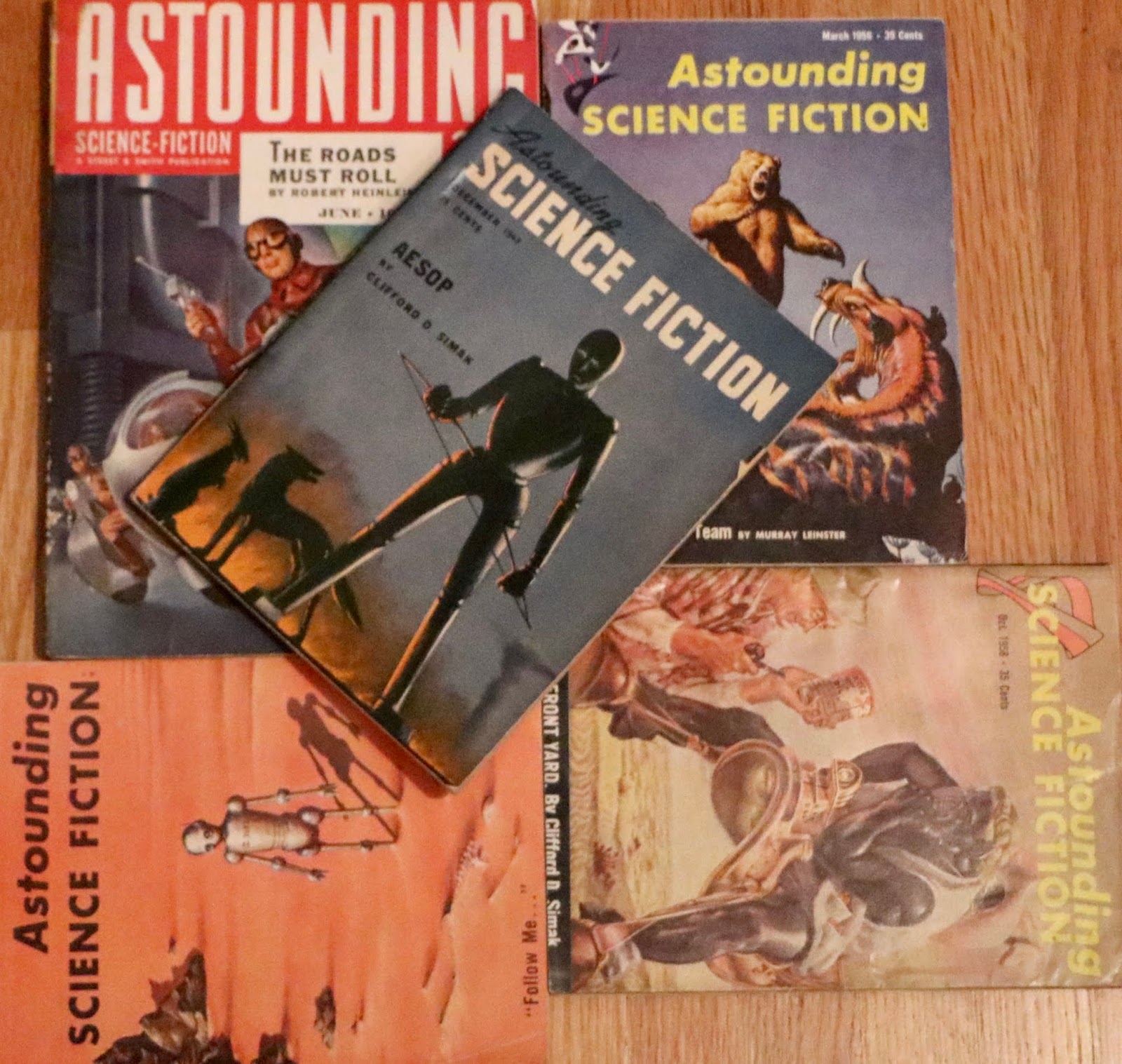
While I had the story in hardcover, I initially read the Omni version. As followers of this blog might guess, the illustration by Robert K. J. Killheffer also enthralled me. 

My version

"Thirteen Phantasms" alternates storylines — the first concerns the main character Landers who is living in a rented house in Southern California. He mentions a wife, Janet, who is no present. I assume she has died. Blaylock's characters often seem to single widowers, which infuses the story with a certain melancholy or bachelors. Either way, this allows them to indulge their pension for kaleidoscopes, stuffed axolotl and spontaneous road trips. He seems to be at loose ends; he does not, for example, seem to work. While speaking to his landlady, he learns that her late husband kept a collection of magazines in the attic. " against the north wall, lay four dust-covered cardboard cartons — full of “junk magazines,” or so Mrs. Cummings herself had told Landers this morning. "The cartons were tied with twine, pulled tight and knotted, all the cartons the same. The word Astounding was written on the side with a felt marker in neat, draftsmanlike letters. Landers wryly wondered what sort of things Mr. Cummings might have considered astounding, and after a moment he decided that the man had been fortunate to find enough of it in one lifetime to fill four good-sized boxes.

Landers himself had come up empty in that regard, at least lately. For years he’d had a picture in his mind of himself whistling a cheerful out-of-key tune, walking along a country road, his hands in his pockets and with no particular destination, sunlight streaming through the trees and the limitless afternoon stretching toward the horizon. Somehow that picture had lost its focus in the past year or so, and, as with an old friend separated by time and distance, he had nearly given up on seeing it again. "

The first issue Landers pulls out is for Dec. 1947, which features one of Simak's City stories, "Aesop", on the cover. 


Blaylock alternates Landers' story with that of a group of science fiction fans, the Newtonian Society, living in Glendale Califonia in the late 1940s. Russell Latzarel is the president, and the group meets at the home of Roycroft Squires. Squires is a bookseller and small press publisher, and it is the small press publications that will link the story of Landers with that of the Newtonian Society. 

"There were book ads at the back of the magazine, including one from something called the Squires Press: an edition of Clark Ashton Smith’s Thirteen Phantasms, printed with hand-set type in three volumes on Winnebago Eggshell paper and limited to a hundred copies. “Remit one dollar in seven days,” the ad said, “and one dollar monthly until six dollars is paid.”"

These magazines have an almost talismanic effect on Landers. After reading “Rain Check” by Lewis Padgett, he goes to the liquor store for the ingredients for the Highball described in the story. He also indulges in a bit of magic thinking mailing a dollar to Squires Press for a copy of Thirteen Phantasms. Later in the story, he will make the one hour trip to Glendale to visit Squires' former home. 
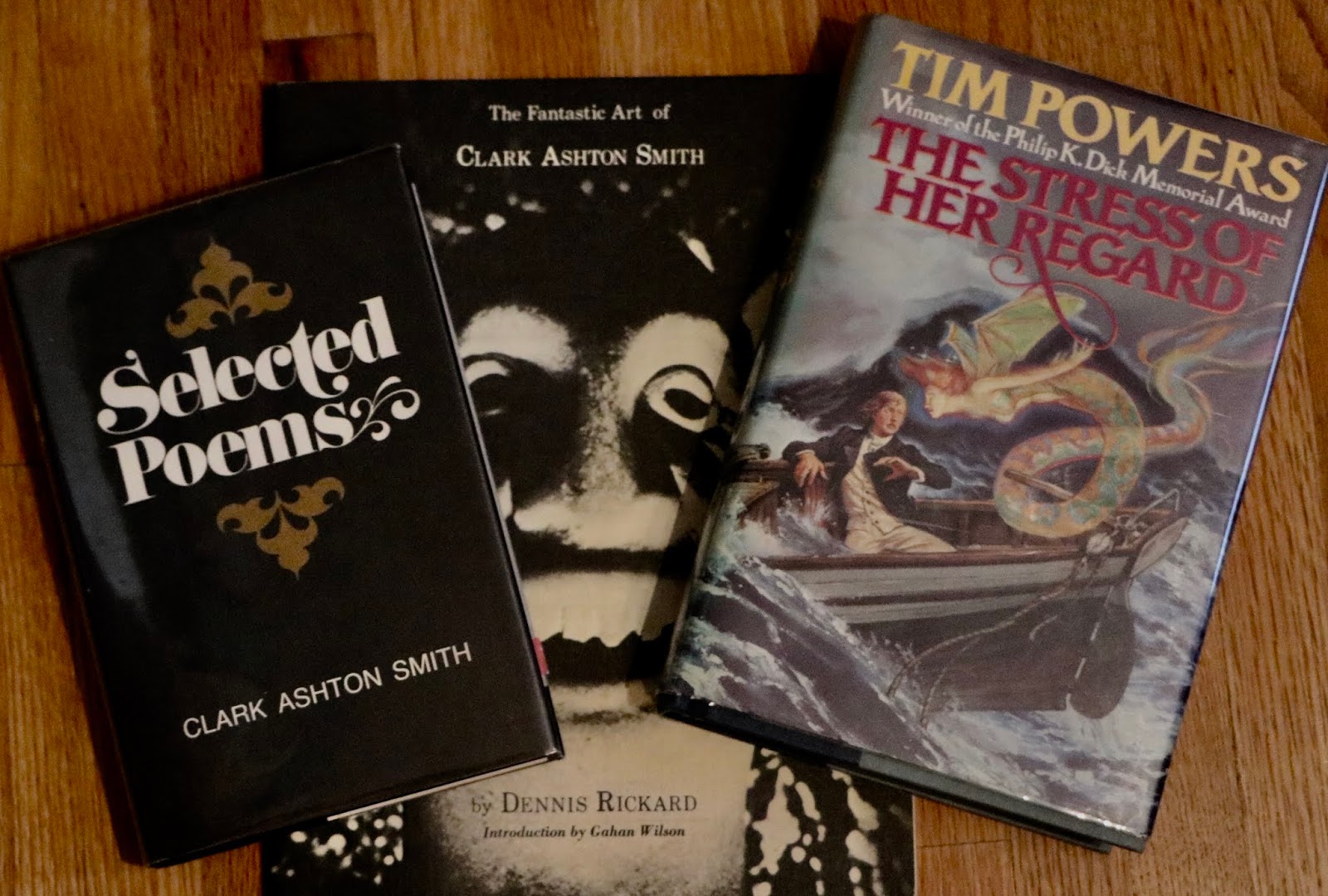

I have attached the link, and I would encourage you to read the story before reading further. Roycroft or Ray A, Squires was an actual fan, bookseller and small press publisher. He was born in 1920 and died in 1988. He was a friend of Ray Bradbury publishing the first edition of Bradbury's story "The Aqueduct" as well as other stories and poems by Bradbury, Fritz Lieber and Clark Ashton Smith. Squires was the literary executor for the estate of Clark Ashton Smith. I think he appears in other stories by Blaylock, but I am my relying on my increasingly faulty memory. I suspect he was a friend of both Blaylock and Powers. The epigraph at the beginning of Power's novel The Stress of Her Regard is from Smith's poem "Sphinx and Medusa". According to ISFDB, this poem only seems to have been published by Squires. While there are lots of Medusa mentioned, I could not find it in Smith's Selected Poems. 

On rereading it I enjoyed the story. However, the section dealing with the road trip to Glendale and Landers' attempt to get directions at the convenience store struck me. The passages perfectly capture his unhappiness with his life and a certain disconnect almost paranoia when confronted with life in Southern California at the present day. But for me, rereading the story in 2019 drove home both the power but also the danger of nostalgia. As a fictional character, Landers' longing for, in his mind, a more uncomplicated or more comfortable society inhabited by people he will find congenial is harmless. But Canada is currently undergoing a Federal election and many issues I thought we had resolved, topics like race, the environment, indigenous and LGBT rights and the rights of women are suddenly flash-points. Many people seem attracted by rhetoric about returning Canada to some (non-existent) golden age. It is hard for me to read Blaylock's story and not reflect on this. I would suggest that a careful reader can be aware of potential problems with a work without ignoring its' merit. I also do not think authors of fiction are writing autobiography and their work should not always be read as such. I do participate in the world of today, I vote and support causes, I think, are important. But like Landers I also find a bit of refuge in a room filled with science fiction and weird tales, both old and new, warts and all. 

Publisher: Roy A. Squires items published by year.

http://www.isfdb.org/cgi-bin/publisher.cgi?29481

Covers

Thirteen Phantasms by Design Bryan Cholfin Ill. Greg Spalenka

Astounding 

"Aesop" by Alejandro

"The Roads Must Roll" by Hubert Rogers

"Exploration Team" by Emesh

"The Big Front Yard" by Freas

Follow Me by Emesh

The Stress of Her Regard by James Gurney

The Fantastic Art of Clark Ashton Smith The Mirage Press 

Sunday, September 15, 2019

The Last American by John Kessel


Earlier I briefly discussed the work of John Kessel here.  
(cover above by Edward Munch)


Some time ago I received this lovely copy of H.G. Wells The Shape of Things to Come from a friend. I had been looking over Last and First Man by Stapledon and wanted to compare the two. So that night I opened the Wells and read the introduction/fictional rational for his book. I will say, while I love historic science fiction and future histories these are books/tomes I delve into rather than read cover to cover. 


I did want to mention the story the Last American does not appear in the Arkham House collection, Meeting in Infinity pictured above.  I read it in the Hartwell anthology. 
It also appears in the Kindle edition The Collected Kessel.

The next day I was meeting a friend at a pub for lunch so I took also the 13th volume of Hartwell's Year's Best. I noticed a Kessel story, 'The Last American The Life of Andrew Steele Recreated by Fiona 13 Reviewed by The Old Guy" Wow it was another future history. This kind of coincidence always charms me.

"In this new biography of Steele, Fiona 13, the Grand of her long career recreating lives for the Cognosphere. Andrew Steele, when he died in 2100, had come to exemplify the twenty-first century, and his people, in a way that goes beyond the metaphorical. Drawing on every resource of the posthuman biographer, from heuristic modeling to reconstructive DNA sampling to forensic dreaming, Ms. 13 has produced this labor of, if not love, then obsession, and I, for one, am grateful for it. Fiona presents her new work in a hybrid form. Comparatively little of this biography is subjectively rendered. Instead, harking back to a bygone era, Fiona breaks up the narrative with long passages of text—strings of printed code."

And what a story it is, we follow Andrew Steele from abused child to blogger, war criminal, incredibly successful writer/producer for movies, religious leader to president. And through the life of Allen Steele we see a world at times distressingly like the most appalling aspects of our own as it moves towards a far-off posthuman future. I don't intend to say more about the story. Rather I will try to convey my reaction. I read, my friend came we had lunch. On the way home I stopped at the CO-OP for groceries. When I went to check out I arrived at the line about the same time as another old codger. I waved him in and immediately pulled out the book to continue reading. I never do that. I seldom read in public and never become so engrossed in a story that I read in line. Kessel's work is very often quite good, the plots are interesting and the twists unexpected.  He often gets me to read types of stories I do not normally read, I don't like time travel, but read "The Pure Product" and "The Miracle of Ivar Avenue" did I like them? I am not sure, but I remember them and I looked for more of his work. I have no interest in stories about politics and the near future. That said "The Last American "is one of the best reads I have had in quite some time. I indeed to read it again just to see how he did it. And I will be reading more of Kessel's work in the future. You should as well.

I am a bit rushed today so I apologize for any typos, omissions or oversights etc. 


Wednesday, July 24, 2019

Ian Sales; Far Voyager, New Arrivals; PS Publishing - Asimov's

 Normally new books fron the excellent publishing house, P.S. Publishing end up on my H.P.L. blog but these definately belong on Jagged Orbit. (These items were all on sale, and the shipping was reasonable.) As always I lean towards the short story format. I am especially interested in the story "Far Voyager" by Ian Sales whose blog I have followed for years.  https://iansales.com/ 

The Best of Ian Watson cover by Jim Burns
Extrasolar cover by Tomisalv Tikulin
Far Voyager coiver by Philp Simpson

"Far Voyager" by Ian Sales. I am not that big a fan of near future, Apollo era science fiction. That said "Far Voyager", an alternative history of the program is one of the best science fiction stories I have read in several years. Sales presents us with a manned Voyager 1 probe, which after 37 years is about to enter the heliopause. In his introduction, Sales speaks about the importance of the human element and in the character of the astronaunt, (the Admiral) we have a fully realized human being with all the foblies, frailty, vanity and the occasional impulse towards the heroic that one would expect in a man who went through the Apollo training. The story is low key, any information we need to understand the setting is presented naturally as part of the Admiral's thoughts or his interactions with Earth, There are no info-dumps, we get what we need and enough to fill in any blanks ourselves. The passsage of time is conveyed effortlessly with simple references to audiocassettes and a computer mouse. The other day I was reading Simak's non-fiction book  The Solar System; Our New Front Yard and in it he discussed the dangers of radiation in any attempt at long term space flight. Sales handles this problem casually and elegantly and when I mentioned it to my wife she said that was one of the potential solutions she had read about. I enjoyed the Admiral as a character and the opportunity to "listen" in on his thoughts was a high point of story. It really spoke to me about the era of the Apollo and Voyager programs and our thoughts about space exploration at the time. 


I also have been considering some science fiction magazine subscriptions, so I dug out some yard sale issues of Asimov's Science Fiction to see how I liked them.


Asimov's covers L to R Bob Eggleton, Gary Freeman, Greg Lafevere

Friday, July 19, 2019

July 2019 and A Simak Summer


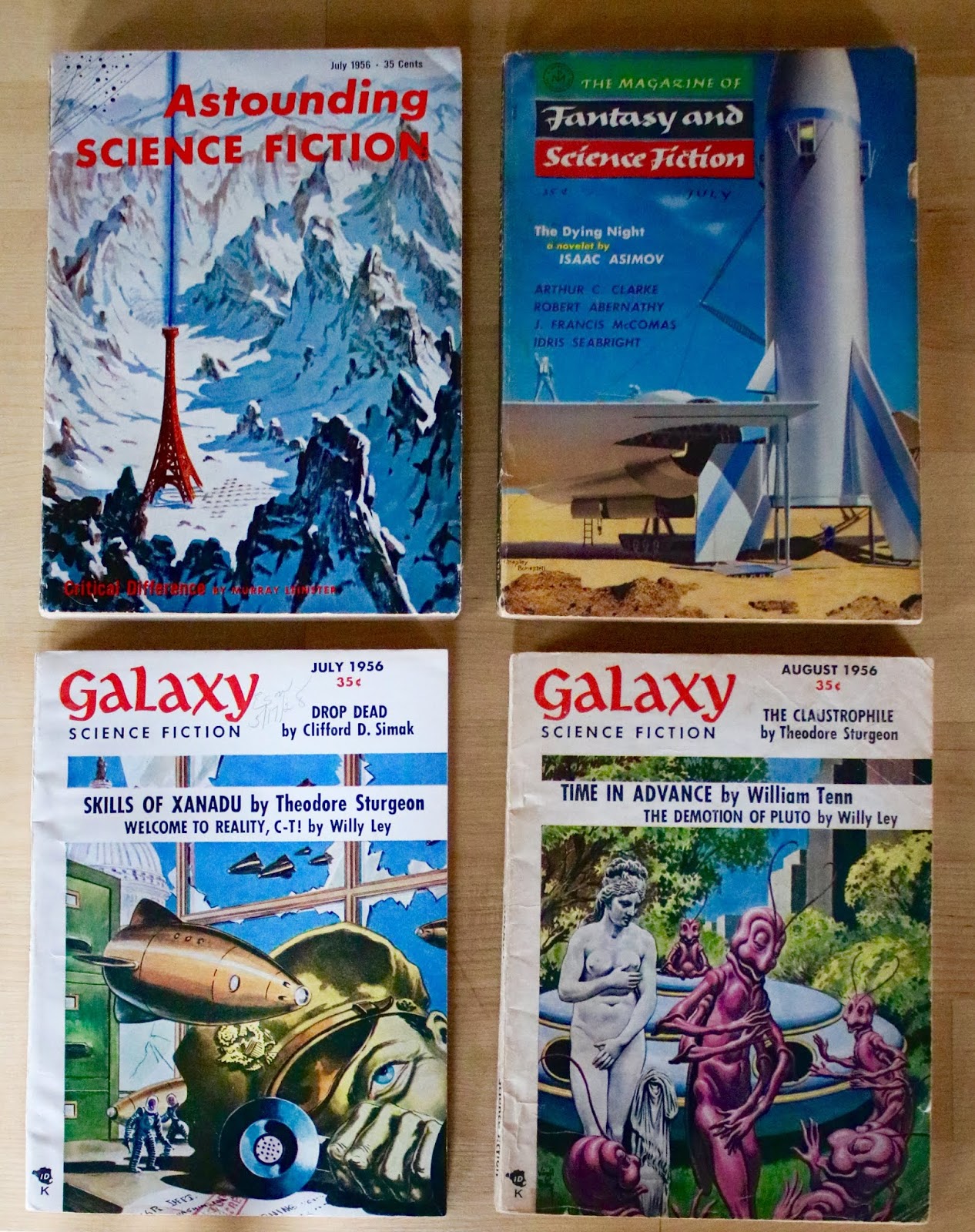
I am a terrible procrastinator, so every summer I surround myself with art supplies, carving tools, and books and magazines to read. I accomplish none of it. I have also set goals this summer I decided to read 3 digest magazines representing the major science fiction titles Galaxy Science Fiction, Astounding Science Fiction and The Magazine of Fantasy and Science Fiction. All are the July 1956 issues, so I can see how the contentts, authors, themes, etc. differ. At the last minute I picked a couple more 1956 Galaxy magazines, cool covers after all. I did not look at the ToC first, so they were not cherry picked in that respect. I am not sure if I will read them cover to cover. I am already way behind so we will see. 


The second project, that is even more behind is A Simak Summer. In my youth when I began reading science fiction, the so called big three were Heinlein, Asimov, and Clarke and I read them all. But I also had another big four that were equally important to me, Andre Norton, I am firing my Norton blog back up there is a link on the right under My other blogs. 


John Wyndham, I am sure we covered some of his books in school but it’s foggy. I read much more of his work than was required because I enjoyed it. Ray Bradbury whose stories are still with me. And last but not, as they say least, Clifford Simak. I have read many of his novels and short stories.

Collecting different editions and appearances of his work has also been one of the focuses for my mania(?), which sees me with way too many books.  Open Road is publishing his complete short fiction, I think it runs to 12 volumes, so there is a lot of material to cover. I have included a link in part because of the crazed look a younger Simak has on the author photo.

https://openroadmedia.com/contributor/clifford-d-simak/

Simak is also an author Doug and I often discuss in our weekly talks, so it seems doubly appropriate. Simak’s story was “All The Traps of Earth” was also the first story covered on this blog. Given Simak’s recurring use of autumnal settings and imagery maybe the series should be called Simak the Autumnal Man, but whatever. With luck the series will run for years regardless of the season. 


Now I am off to put together a post on our friends the Franklin's Ground Squirrels, which will appear here, and at least demonstrate that I do complete some posts over the summer I include the link.

http://thatsjustthewildwood.blogspot.com/

Then I have some reading to do.


The first illustration is by John Schoenherr, for Clifford Simak's "New Folks Home" Analog Science Fact - Science Fiction, cover by Van Dongen


Astounding Science Fiction, cover by Van Dongen

The Magazine of Fantasy and Science Fiction, cover by Chesley Bonestell

Galaxy Science Fiction,1956 July cover by Jack Coggins
August cover by Virgil Finlay
April cover by Emesh

Sunday, July 7, 2019

New Writings in SF5 edited by John Carnell (Part Two)


“Acclimatization” by David Stringer

I hated this story, I was unengaged with the main character, a spacer Gerry Kaufman, who returns to earth from his first trip to Deepspace then whines about it. I also found the future history setting and plot uninteresting. So I will stop here, one thing I said when I started this blog was if I have nothing nice to say…, sometimes I am unsuccessful. But I try.

If you want to read some stories about rather odd conquests of space I suggest Larry Niven’s stories of Beowulf Shaeffer, “Neutron Star” is a great place to start or the many really enjoyable stories of Cordwainer Smith, I don’t have his books at the cabin but start with “Scanners Live in Vain” and “The Lady Who Sailed the Soul”. Or better yet find them all by reading everything he wrote. Moving on. 

“The Expanding Man” by R.W. Mackelworth

from Carnell’s introduction, “ Not all science fiction stories require a complex plot or setting to make them acceptable. The following story, set in a park, is solely a conversational piece, but its implications prove far-reaching.” 

The conversation is between Algie Ryan and a stranger he has met in the park. They are seated on a bench while Ryan recounts a somewhat incoherent story concerning his wife. While the stranger ( he provides the name Smith) pretends to lend a sympathetic ear, this is not what he is interested in. It seems that Ryan had spoken to another stranger, who subsequently vanished. Smith wants to know what Ryan told him. As he says “you are the kind of man who confesses, Mr Ryan. All confessions fun along the same line-a protest, a windy grumble with tensions running out in an acid stream.” (107)

Spoilers ahead
I am going to quote a bit more because this is a really well-written story. The description of the park, the back and forth between Ryan and Smith are beautifully realized. 

Finally, Ryan describes his encounter, “ I sensed he wasn’t ordinary, that he was from out of this world, and I accepted it. Then, as I told my troubles he seemed to grow until he filled the whole of my view.” (108) As Smith is able to demonstrate Ryan means this literally. Because Smith and the previous stranger are aliens from two different factions and in contacting Ryan a rule have been broken. Ryan goes on “ “he took them on he grew larger with them…until he was enormous, a great skinful of my problems, of small household nags and big bank tyrannies. I thought he would explode.” “It is trick, a conjuring trick for ignorant natives! He broke every political agreement and every solemn pact of non-interference that’s ever been made in this sector of space-time merely by speaking to you.” Smith spoke like a small-town politician who hadn’t time to fix the ballot boxes and knew he had lost to the other candidate. The other side was breeding a nimbler race of mice.” (109)
From this description, it may seem like a fairly ordinary story of two extraterrestrial visitors vying for mankind’s support, but Mackelworth’s story is far more complex than that, and Ryan is very much an unreliable narrator. This story has, to me, more of a New Wave vibe than the other fairly conventionally plotted stories in this collection. But I absolutely loved it, well written, nicely plotted with great dialogue Mackelworth is another writer I will look for in the future. This collection seems to be it’s the only appearance of this story.

“Treasure Hunt” by Joseph Green

Professor Soames Chalcedony was a Philosophy Professor and spokesperson for a group advocating that longevity treatments be extended to everyone, at present, they are restricted to the rich and the influential. At 80 years of age, while still in good health, Chalcedony has opted to have his body submerged into the Mediterranean in a coffin. Here Chalcedony will live through a thousand years of dreams for each day his body takes to die. But his body has now been stolen for use in a treasure hunt. He is told “You are a mental pattern, a matrix of electrical fires taken from one mind and forcibly imposed on another. “ (118) in a few hours the original mind will reassert itself and Chalcedony’s mind will fade. They go on. “We are on a treasure hunt. We are after the fresh-laid egg of the firebird, The most beautiful object in the galaxy, and this is the only way one may be obtained. You were chosen to share this effort with us because our computer selected you as the philosopher most likely to succeed. It seems Chalcedony has been retrieved by four adventurers who found alien mind transfer equipment on a remote dead planet and decided to retrieve an egg to pay for longevity treatments. One has already died and a second has been brain damaged. The other two men have tried but failed to retrieve the egg. 

To retrieve the egg one must assume the form of chariot-horse.

Chalcedony sees his new body as a reflection in a pool of liquid mercury “seeing the plump, rounded armless body, heavy tapered tail, snake-length of neck topped by a blunt and broad-nosed dragon’s head, the open mouth showing pointed tongue and diamond glitter of teeth in the wide wicked jaws. He looked at the two wheels of bone that supplied his locomotion as he moved away, at the massive bones which protruded from both sides of the muscular abdomen” (117) 

He is on a planet where life is based on silicon, a world of crystal growths. “When he moved he gave off light, and he now realized this was true on every plant and animal on this sphere. His borrowed eyes knew and allowed for this. He was a humble vegetarian, with teeth of diamond and stomach of hydrofluoric acid, there were growths of prisms, seed carriers of crystal bells, fruits of gemmed translucency that were his food.” (122) If he succeeds Chalcedony will be rewarded with longevity treatments and a place on the crew if he wants it. But first, he must navigate a very strange landscape. 

The story is not long but Green has offered a really beautifully depth of description for the silicon-based forest. Honestly, this is what I originally signed up for when I began reading science fiction. Utterly alien, aliens and strange planets based on totally different physical laws and an adventure to boot. All that it needs is a great cover by Frank R. Paul dripping with crystal forests, prism mountains and battling dragons with wheels. Again it looks like this collection was its only appearance.  

“Sunout” by Eric C. Williams

With this title, and the description of the death of the sun in the review, (the story is falsely attributed to Mackelworth in the review), I am not too worried about spoilers, this is an okay story dealing with the discovery that the sun is about to go out, by the staff of an observatory. The plot revolves around what to do with the information some opt to publicize it right away and some including the head of the observatory wants to tell the president and other heads of state so they can prepare of the resulting panic. I said in discussing the first story in that collection that otherwise so so stories can be redeemed by the ending. “The Secretary went down a step and greeted the President with an urgency showing his held-down panic. “This is Professor Weiner,” he said, turning.
The President extended his hand.
The Sun went out.” (162) 


Great stuff. I did not know what to expect from a collection put together by John Carnell but as I said in Part One once I had read a few I knew that I was in good hands. The overall quality and the sheer variety of plots really made for a great reading experience. I have a few more of this New Writings in SF collections and I will keep an eye open for more, as well as looking for other stories by some of the writers I discussed here.