" In this universe the night was falling; the shadows were lengthening towards an east that would not know another dawn. But elsewhere the stars were still young and the light of morning lingered; and along the path he once had followed, Man would one day go again"

Arthur C. Clarke Against the Fall of Night
Showing posts with label Book Collecting. Show all posts

Thursday, October 8, 2020

Bookshelving Marathon - Part 3 The Saga continues


I am continuing this exercise in bookshelfery in part because it is (for me)  an interesting examination of how my mind works and the type of associations that have created my metal map. This shelf contains mostly art books. The central portion is devoted three artists, Shaun Tan, an Australian artist who has produced a number of children's books. They deal with childhood, colonization, immigration and the environment and are well worth seeking out. 
https://www.shauntan.net

It also houses Nick Bantock's work. Bantock, a British artist, living in Canada, is best known for The Griffin and Sabine Saga. 

  
There are some current art books and some Tiki figures on the left. Helen and I are redoing part of our basement as a mid-mod game room/library so they might end up there in the future. I also have a Players cigarette tin I picked up at a yard sale because I remember my father smoking them briefly when I was a child. He wore a similar outfit when he was in the RCN. The big books on the right include illustrated copies of The Voyage of the Beagle and The Origin of the Species by Darwin. There are also two shelves in the basement about Darwin, his contemporaries and evolutionary theory in general. I started reading the Origin in high school, and it has stuck with me. The second real vacation we took was to the Galapagos. As previously mentioned, Helen is a wonderful woman. 


Lastly I have works devoted to the Canadian Artist Ivan Eyre. I saw his show Ivan Eyre: Personal mythologies/images of the milieu: figurative paintings, 1957-1988, while working at the U of C for the summer. I went  to the show every week it was there, I believe it as free on Tuesday. Later I worked in the Esso library which had his mammoth painting Floodwood hanging on the wall. I moved to Gulf Resources and had a print of his painting Red Hill, which appears on the cover of the Woodcock book, in my office. I have also been lucky enough to obtain some of his smaller works for my study. I will not include photos, artist hate that. And ditto on my previous remarks about Helen. So it seemed his work followed me, and his imagery has stuck with me since then. One repeated image he uses are figures, often horn blowers silhouetted along the edges of tall buildings. Helen and I are often reminded of these figures as we move about in the city. 


There is also a bison paperweight I picked up on a trip we took to Drumheller this week to have lunch with friend. Bison have a particular resonance with me. When I was in archaeology, I often worked with faunal remains from fur trade posts or buffalo jumps. I also assisted the faunal curator in dismembering seven bison for comparative collections. (All were accidental deaths within Elk Island Park.)

I had hoped to finish but stuff happens, the NHL Draft, some very circumspect social events, insomnia, the front retaining wall, (now finished,yeah) i.e. life. So the last shelf will have to wait. 

Friday, October 2, 2020

The new bookshelf or my life remembered in objects (Part Two)

Some time ago, the "Big Bricks," as Bud Webster used to refer to the large hardcover science fiction anthologies, found their way across the hall and into the bedroom, hence the need for the new shelf. (For Bud's columns) see the Handy Resources on this blog. They remain here on shelf three along with a few H.P.L. titles however the bulk of this material remains in my study. 


One item I did bring over was The Viking Portable Library Novels of Science, which contains Lovecraft's "The Shadow Out of Time". I think this is one of Lovecraft's best stories and one that is clearly science fiction. It is perhaps indicative of a path Lovecraft might have fruitfully continued had various issues on conspired to derail his writing career. It is also one of his first appearances in hardcover. "In 1945 Wollheim edited the first hardcover anthology from a major publisher and the first omnibus, The Viking Portable Novels of Science." 


I am quite interested in Wollheim's relationship with the mythos and intend to pursue it further.


On the right side of we see three items that have some significance for me. My mother-in-law, a successful artist, painted the tile. The wren was carved by Art, an older gentleman who took painting lessons from her. Years later, he took up carving, and we often encounter him at summer craft shows. I am impressed with his birds and has happy to buy this example. The tower with the two balls carved inside so they can move without falling out came from the home of my Great Uncle Lorne. I believe his wife Nellie's family was in the lumber business, so it might have come through them. I never knew Nellie. When she died, Lorne boarded off the upper floor of the big brick farmhouse they lived in. When I knew him, there were two almost impassible and fascinating downstairs rooms full of knick-knacks and furniture, including an upright piano and an organ you pumped with your feet. Lorne lived in the kitchen, sleeping if I remember correctly, on a couch. When he died, and we went upstairs, it seemed he had simply gone downstairs one day, leaving anything he did not want in place. 

He was kind to me; when we went to visit, he had saved the toys that came in the cereal boxes on the window sill for me. I remember blue plastic Inuit or arctic explorers. I wish I had them today. It has been some 50 plus years, so my memory may not be that accurate, but that is the gist of it. 

I think I will cover the last two shelves tomorrow. I am enjoying the exercise and I am in no hurry. I just realized it is Oct and I have to dig out A Night in the Lonesome October by Zelazny, I am already behind.

Let's end with a Pika from a recent trip to the mountains.

Saturday, February 22, 2020

And take the hidden paths that run Towards the Moon or to the Sun.

  My two favourite fantasy trilogies are The Riddle Master by Patricia A. McKillip  and The Lord Of the Ring by J.R.R. Tolkien. Tolkien's work has been a big part of my life and imagination since my teens. I have a a couple of books concerning Tolkien's experiences in World War One and how they may have influenced his writing currently waiting on my Kindle. I also loved his illustrations and recently used Christmas Gift cards to purchase the book Tolkien:The Maker of Middle-Earth by Catherine McIlwaine, about a 2018 exhibition covering the life and worlds of J.R.R. Tolkien that was held at the The Bodleian library. 

A link to the exhibition is here.
https://tolkien.bodleian.ox.ac.uk

I have been reading Megan N Fontenot's great series on the People of Middle-East running on Tor.com and really enjoyed the essay.   

The People of Middle-earth: One Ring to Rule Them All
https://www.tor.com/2019/09/19/the-people-of-middle-earth-one-ring-to-rule-them-all/

I have enjoyed it enough that I am considering looking for the History of Middle-Earth which runs to a rather daunting 12 volumes. But the basement renovation continues and many books have been boxed so I will probably wait until I can see what I already have. We did discover a couple more electrical outlets as we moved stuff so the process has sped up.  

There have been a couple of significant deaths in the Tolkien universe in 2020, as I am sure you are aware. His son Christopher, who was responsible for the bulk of his father’s posthumously published work passed away January 16th.

https://www.theguardian.com/books/2020/jan/20/christopher-tolkien-obituary


And Barbara Remington, the illustrator who created the most widely recognized covers for J.R.R. Tolkien's “The Lord of the Rings” trilogy and “The Hobbit” passed away on January 23rd. 

https://www.nytimes.com/2020/02/15/books/barbara-remington-dead.html

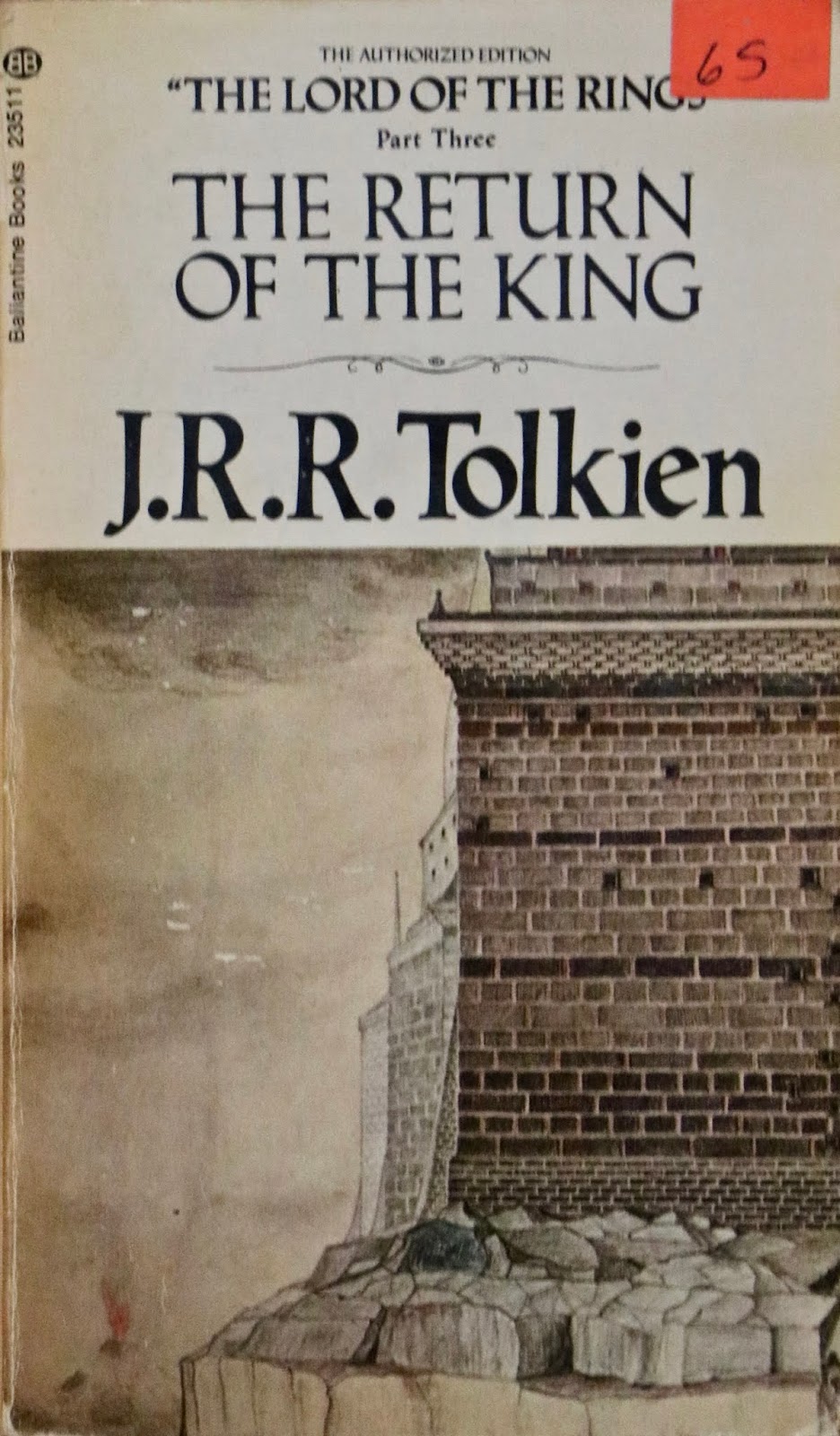
Alan Brown on Tor.com published a lovely essay on these editions and you can read it here. 

https://www.tor.com/2020/01/03/how-tolkien-and-the-lord-of-the-rings-changed-publishing-forever/


I know that when I first saw the Ballantine Editions with the covers inspired by Tolkien's illustrations I was drawn to them. (I certainly need to dig out the hair-
dryer and take the stickers off) However as I have become more interested in book covers and illustration, some editions just strike me as being such an important part of the history, not just of the author's work itself, but also of the genre and the period that I may change my feelings about them. Remington's covers are possibly the greatest example of this, for me personally, which is why I was so taken with Brown's essay. 


"The Road goes ever on and on 

Out from the door where it began.
Now far ahead the Road has gone,
Let others follow it who can!
Let them a journey new begin,
But I at last with weary feet
Will turn towards the lighted inn,
My evening-rest and sleep to meet."

Monday, October 22, 2018

New Arrivals, H.P. Lovecraft, Edgar Rice Burroughs, aging


  A few posts back, I spoke of the death of Peter Nicholls the editor of the 1979, The Encyclopedia of Science Fiction. As I was preparing for that post, I took out my tattered edition and leafed through looking at the pictures. Which meant looking for my favourite, a 1937 edition of Argosy with an enchanting Burroughs cover by Emmett Watson. I then decided to see if there was a decent/affordable copy on ABE. I found one and since one of the main drawbacks of ABE is the initial shipping costs, I looked to see if the vendor has other items I could add. I knew from previous purchases that this vendor, Leonard Shoup, tends to carry Weird Tales related material so I did a quick search on Lovecraft. And there they were. I could not resist adding The Lurking Fear and Other Stories and The Shuttered Room and Other Tales of Horror to the Argosy and now all I had to do was wait until the frantic barking of the dogs signaled the arrival of our letter carrier


When I first began collecting, rather than simply buying books randomly, I focused initially on two areas. Lovecraft with the obvious (to me) addition of Arkham House and other Weird Tales authors, and Edgar Rice Burroughs. I chose Lovecraft because I was introduced to his work by a school chum at 15 and enjoyed it.

These two Lovecraft titles would be considered minor collections at best. The stories in the The Shuttered Room are pastiches or stories based on Lovecraft's notes by August Derleth. The Lurking Fear contains what I think I can safely describe as lesser tales, although I have a certain fondness for the wildly illogical The Lurking Fear, with it's warning against the dangers of inbreeding, cannibalism and a subterranean existence. I purchased them for the John Holmes covers, these were among the first editions (now lost) that I owned.


(Both author's works can be considered problematic in their treatment of women and minorities, I posted my thoughts on Lovecraft here
http://dunwichhorrors.blogspot.com/2016/03/the-real-shadow-over-innsmouth-odd.html )

I chose Burroughs because his books filled the used bookstores of my youth and I loved the covers. James Blaylock in his wonderful Burroughs themed novel The Digging Leviathan expressed this beautifully. 

" Edward St. Ives was a collector of books, especially of fantasy and science fiction, the older and tawdrier the better. Plots and cover illustrations that smacked of authenticity didn't interest him. It was sea monsters; cigar-shaped, crenelated rockets; and unmistakable flying saucers that attracted him. There was something in the appearance of such things that appealed to the part of him that appreciated the old Hudson Wasp …,.  Once a month or so, after a particularly satisfactory trip to Acres of Books, he'd drag out the lot of his paperback Burroughs novels, lining up the Tarzan books here and the Martian books there and the Pellucidar books somewhere else. The Roy Krenkel covers were the most amazing, with their startling slashes and dabs of impressionist color and their distant spired cities half in ruin and shadow beneath a purple sky." (17)


Cover by Timothy McNamara (as by Ferret)

Roy Krenkel below


I have to admit this purchase was rooted very much in nostalgia or perhaps immaturity if you like. I have lately found the rise of irrationalism worldwide troubling and some days the world seems unrecognizable. As I get older my reading and collecting helps keep me mentally active, engaged and grounded. The process of aging has been beautifully described by Wendell Berry in his novel (a favourite of mine) Jayber Crow.

 "Back there at the beginning, as I see it now, my life was all time and almost no memory. Though I knew early of death, it still seemed to be something that happened only to other people, and I stood in an unending river of time that would go on making the same changes and the same returns forever.
     And now, nearing the end, I see that my life is almost entirely memory and very little time." (24)

I try very hard to avoid wallowing in memories of the past, and make sure that I read new and diverse works and authors, but I, like Edward St. Ives, cannot resist the occasional winged T-Rex. 


Sunday, September 24, 2017

Penguin SF


My wife and I are planning a trip to London shortly and I have been hoping that I will be able to pick up some SF titles while I am there. One thing I wanted to do was look at which Penguin SF titles I already have and which titles I would like to look for in the London bookstores. 

It was also a great excuse to present some of the titles I already own. A quick look at the titles displayed at the link below, will demonstrate that the art directors for Penguin Books have embraced a number of different strategies, since they started publishing SF in 1935 with Erewhon by Samuel Butler.

My earliest Penguin in actually a television script for The Quatermass Experiment published in 1959. As Penguin frequently reprinted with the same covers it is good to look at the copyright page if you want first editions (thus). I am hoping to find some earlier novels, maybe even Erewhon?

A great resource for my search has been

http://www.penguinsciencefiction.org/ .

For a look at some of the travails and triumphs of a collector of Penguins SF titles I recommend searching the Penguin posts on theunsbcribedblog

https://unsubscribedblog.wordpress.com/2014/12/03/a-plethora-of-penguins-part-one/

For some general remarks on collecting Penguins including the SF titles, this article in the Guardian is good.

https://www.theguardian.com/books/2010/jul/30/penguin-books-turns-75-anniversary

The Quartermass Experiment, (above) has the horizontal orange and white triband covers I associate with Penguin Books.

Here the triband is now vertical. Limbo 1961.


It gets a bit more stylish below, After The Rain, 1958, cover illustration by Quentin Blake.


Then we also have a movie tie-in complete with scary kids.


The World in Winter, 1965, with a cover illustration by Bruce Robertson.


I have read a number of Hoyle's novels with The Black Cloud being my favourite so far. This cover, where the designer played with the iconic orange in creating a unique image, is one of my favourite Penguins.


A number of illustrators have done the covers for a series of novels by the same author. Here is one of the covers Peter Cross did for a novel  by John Boyd, I would love to find a copy of Boyd's  The Pollinators of Eden. I am hoping to find Penguins with covers by artists Alan Aldridge, David Pelham, Peter Tybus and Peter Goodfellow, and authors like Philp K. Dick, Frank Herbert and some of the Penguin anthologies.


Some of my favourite Penguin covers  are illustrated by Peter Lord, where the central image intrudes into the white border, in this series of novels by one of my favourite author John Wyndham. I will be looking for more of these.


And Penguin had done a number of paperbacks there the illustration covers the entire field.