" In this universe the night was falling; the shadows were lengthening towards an east that would not know another dawn. But elsewhere the stars were still young and the light of morning lingered; and along the path he once had followed, Man would one day go again"

Arthur C. Clarke Against the Fall of Night
Showing posts with label apocalyptic. Show all posts

Saturday, October 15, 2016

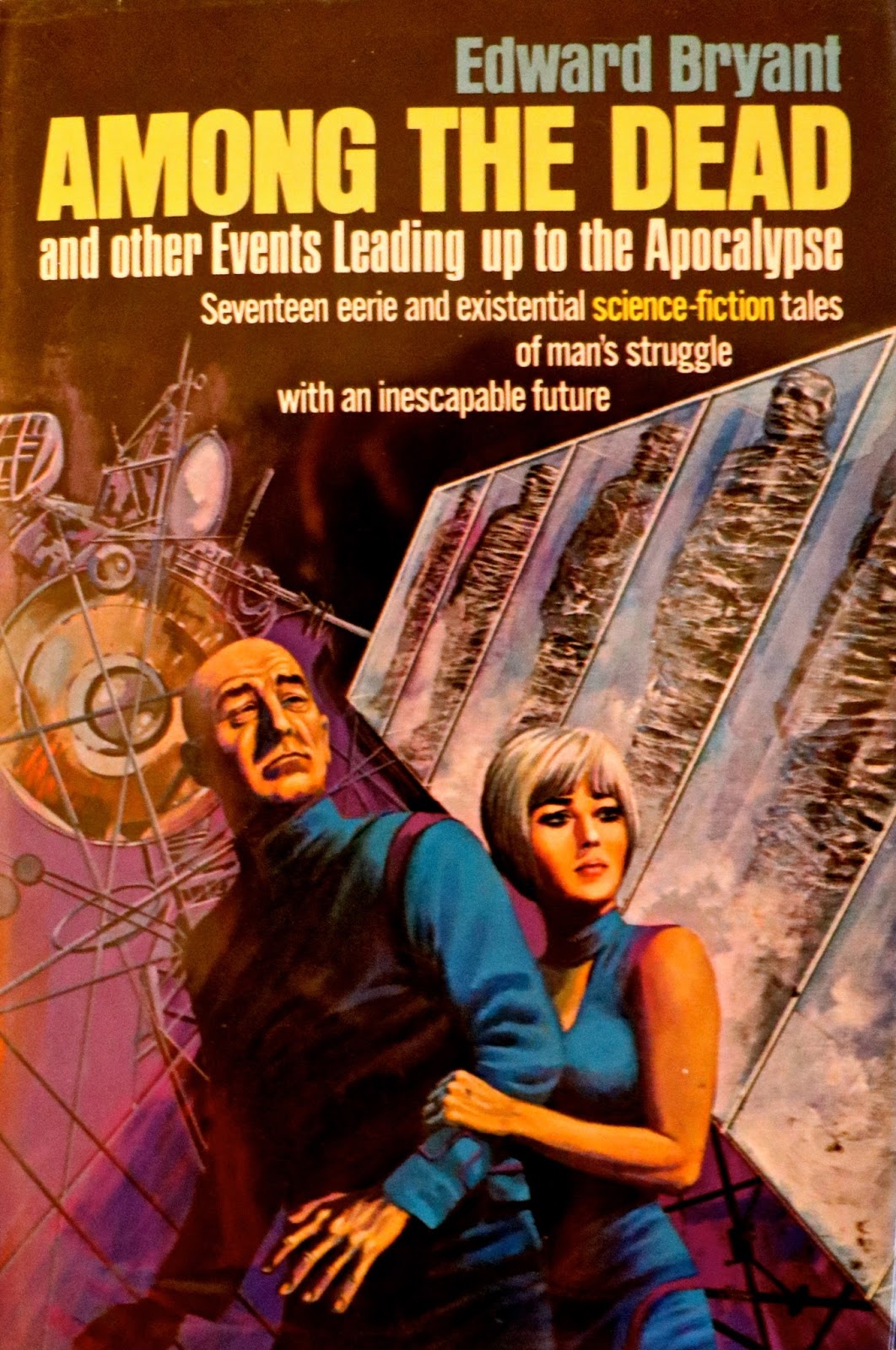
Among the Dead and other Events Leading up to the Apocalypse, Seventeen eerie and existential science-fiction tales of man’s struggle with an inescapable future. By Edward Bryant, 1973, MacMillian, cover by Gray Morrow.

Today I am going to do something a bit different which is post on a collection of short stories rather than a novel. First I will give my impressions of the entire volume and then look at some of the stories in more detail. I guess the stories in any volume mentioning the apocalypse would not be cheery and here Bryant does not disappoint. I have never read anything by Bryant before so I am not sure if these stories are typical of his output or if they unusually dark because of the theme of the collection. The stories also raise a couple of other issues that I often ponder. I am always interested in how porous the boundaries between genre fiction is so that SF often is heavily influenced by mysteries, Asimov’s Caves of Steel/Naked Sun come to mind or for horror George R.R. Martin’s Nightflyer is a great example. In this collection I do see a strong horror element in many of the stories. Also I often wonder what constitutes SF, this something I still do not have a concise answer for. I think it is very different things to different people and certainly some of the stories in this collection raised that in my mind. I did expect from the subtitle that these stores might share some progression or continuity but that is not the case. While most point to some kind of societal disruption it can be overpopulation, nuclear attack, terrorism, biological weapons, class warfare or some kind of creeping ennui as far as I can determine. The stores are more closely tied together by characters infected with a certain world weariness, impotence, ineffectualness, or sexual disfunction. Victimization is a theme that seems to run though may of the stories. We can also throw in hints of bestiality, torture tales and some cannibalism so yes they are dark. For me some of the most successful stores were those that hewed most closely to some more predictable SF trope. This is a personal preference not necessarily a fault of the author. I did notice that I often liked the longer rather than the shorter stories in the collection. It seemed the added length allowed for more character development or a more clearly defined plot. Some stories were so short, the theme or plot so poorly developed that they did not hold my interest. Often when I read SF I consider the plot or characters in terms of other SF I have read and I will continue this here. I am only going to discuss selected stores to be quite honest some I did not like others I simply did not see much of a point to and did not feel like rereading. However since I did typify this as a journey I am going to try to read books and authors that challenge me. 

Shark: This is the only story in the collection I can say I really enjoyed. Marcus Antonius Folger is an oceanographer formally of the Marine Institute on East Falkland who has spent the last decade in a village on small island in the south Atlantic. During the war he was part of as project to weaponize sharks and killer whales using human volunteers. Now he lives quietly on the island occasionally helping the islanders with war “relics” until representatives of the Protectorate of  North America come to recruit him for an unnamed project. The SF element seemed a bit weak but the backstory and the island setting were defined enough to make the story work for me. 

Adrift on the Freeway: Richard Forrester is an professor at Kenner State College and logical successor to the current head of the English department. On a driving trip to a conference with a colleague they speculate on the growing phenomena of cars abandoned on the freeway with not trace of the occupants. He also indicates his unhappiness with his career in such a provincial backward college and community. This story seemed more closely related to the meditations or fabulations of Ray Bradbury’s later stories than typical SF story. 

Jody after the War: A somber look at love after a nuclear war. Dated a bit by having one character work as phone booth repair man.

The Poet in the Hologram in the Middle of Prime Time: Ransom an unsuccessful poet has become increasingly unhappy with his paying job writing scripts for Unicorp the North American leader in holovision programming. But his frustration boils over when the network Director General Amelia Marchin indicates that new technology will allow viewers to participate in the actual scripts using subliminal cues and that feedback circuits will allow viewers to direct the action and alter the program as they desire. Here we have the parlour walls of Bradbury’s Fahrenheit 451 taken to their logic conclusion creating a technology close to the virtual reality of our cyberpunk future. 

The Human Side of the Village Monster: Terri and Peter live in a dystopic New York reminiscent of the darker visions of the late works of John Brunner. Attempts at population/social engineering have created widespread crime, food shortages and the necessity of carrying respirators when venturing outside while going to get Terri’s contraceptive medication. Their lives are further disrupted when they invited to dinner by a neighbour. This story has more of a SF gimmick story feel in the final denouement but I am not sure this fits with the rest of the story.

Among the Dead: A somewhat grisly take on the last 2 men and 1 woman in the world story.

I deliberately did not research Bryant before reading this collection. I see he has won 2 Nebula awards for short stories, they do not appear in this collection, and that he has a slew of award nominations. In the entry in The New Encyclopedia of Science Fiction edited by James Gunn the entry notes that many readers have questioned whether Bryant’s stories like “Shark” are SF the entry goes on to note that “Indeed most of Bryant’s stories are obviously science fictional, but he presents them as fables rather than stories of credible, detailed worlds.” It also states “His well written and stylish short stories deal with tense social and psychological issues.” While I cannot dispute the latter I did not find most of the stories in this collection either well written or stylish. This indeed was a problem for me, I feel that short stories should be richer more evocative than a novel with strong imagery and a well invoked setting or characters they should not be as discursive or confused as I found some of these stories to be. Based on the industry response to his stories it is obvious that Bryant is considered a very good short story writer and it seems that Bryant’s themes and writing style simply do not resonate with me. 

I did like the quote from Dante in one story;

"There is no greater sorrow than to recall in misery the time when we were happy"

Inferno, Canto V, lines 121-123.


Saturday, January 24, 2015

The Committed Men M. John Harrison


 The Committed Men M. John Harrison, Panther Science Fiction 1973, cover by Bob Haberfield.


  I have to admit that, after reading Harrison’s Pastel City, I Googled to see what else he had done and fell in love with this cover (so much so, I read a library copy rather than my paperback edition). To supply some background Harrison is identified with the New Wave and the writers Moorcock and Ballard especially.This book is dedicated to Mike and Hilary Moorcock and the protagonist keeps a photo of J.G. Ballard among the detritus he has accumulated in his Nissen hut.

We first meet the protagonist, Dr. Clement Wendover in the prologue. As he watches the few remaining vehicles traveling a motorway which has been fenced off, he has been told to, “contain accident effects and protect the urbanized sections of the motorway from damage,” an accident occurs even as Wendover watches.  This a perfect introduction into the sensibilities of the New Wave. The lone observer, ruined motorway, and inevitable accident scene are right out of the themes of J.G. Ballard. We are quickly told that Wendover’s society has broken down because an unexplained release of radiation has caused an increase in skin cancer. As is often the case with apocalyptic science fiction, especially the New Wave the cause of the disaster is unimportant the results are the main driver of the plot. James Gunn, in his introduction to The Road to Science Fiction #4, explains how New Wave writers differ from previous science fiction “ The customary difference is that the cause of the change was often omitted, because it was unknown or unknowable, and the people to whom the changes happened seldom inquired into the causes because the changes were so massive that causes were irrelevant or so mysterious that inquiry was futile, or because the people were incurious, or were benumbed by events or life itself, or had lost their faith in rational inquiry. The reasons why causes were minimized may be various, but the effects were clear: Rationality was short-circuited (if the causes are unavailable, solutions are so beyond reach as to make the search unthinkable) and characters became victims.” We quickly learn that Wendover at least realizes that things are only going to get worse and this view is clearly demonstrated in the argument he has with his wife Vanessa before she leaves him. Then, in a bit of authorial sleight of hand that left me breathless with admiration, (I hate a lot of back story),  the first sentence of chapter one begins “some time, later” and we are off.

My impressions: while definitely New Wave The Committed Men does not suffer from the heavy handed stylistic excesses of some New Wave, we are spared badly written stream of consciousness digressions, there is a straight forward story involving a journey/quest. I initially characterized The Committed Men as a cozy catastrophe a category characterized by such works as the Day of the Triffids or The Kraken Wakes by John Wyndham . The term cozy catastrophe was coined by Brian Aldiss in the Billion Year Spree, when I reread Aldiss’s description in the now Trillion Year Spree he characterises it this way “ The essence of cosy catastrophe is that the hero should have a pretty good time (a girl, free suites at the Savoy, automobiles for the taking) while everyone else is dying off.” P316 While others have embraced and perhaps expanded this definition, by Aldiss’s description The Committed Men is too bleak, the consequences of this disaster for both the protagonist and society as a whole too severe, to fit this category. 


 I also felt there was a connection to other more conventional science fiction works like Search the Sky by Fredrick Pohl and Cyril Kornbluth in which the main character takes a rather satirical journey to visit a number of interstellar colonies. As one might expect from a New Wave novel The Committed Men is a much darker with a fairly ambiguous ending. I was pleasantly surprised at how much I enjoyed it, at under two hundred pages it was a quick read with a compelling plot, lots of action and twists that kept my interest. It is a perfect introduction to British apocalyptic science fiction and New Wave themes in particular.  One quibble is the rather, to me, inexplicable meetings between several of the main characters and a rather oddly dressed young man which seem to serve no real purpose. It was only after I finished the book and Googled some other reviews that I learned that this was Jerry Cornelius, a character created by Moorcock and incorporated into their works by a number of other writers.

Spoilers

When we join Wendover after the collapse of the British society he is living a fairly aimless existence snaring rabbits for food and living in a junk filled hut. He avoids prolonged contact with fellow survivors. This is an existance typical of many New Wave characters, who often seem to be waiting rather that acting. That changes when Harper a young man from the nearby community of Tinhouse and a dwarf named Arm, a survivor from one of the local armies arrive. They enlist Wendover in a house call to visit a newborn for the local strong man Holloway Pauce. Arriving at the village Wendover finds the baby is a mutant covered with a dry leathery skin. We learn that similar mutants have been born, but Pauce has killed them. It is then Wendover acts

" At that point, Wendover committed himself. Up until then, he had watched the decline of the world with passive acceptance; taken refuge in dreams because he could not bear the present. His memories had not been the stigma of senility but those of retreat. Because the child represented somebody's future, he became involved with the present.
He shot Pauce without taking the pistol out of his raincoat pocket. "

It is at this point we meet the committed men, as Wendover, Harper and Arm, later joined by a young woman Morag who nurses the child, begin their journey across the ravaged landscape. Along the way we meet the bureaucrats, characters worthy of Swift or Peake, with their papier mache heads and endless forms, “ The door opened fully on a strange miscegenation. The disgusting head was set on narrow, stooped shoulders. There seemed to be no neck. A thin pot-bellied body twitched beneath it, dressed in dirt glazed black coat, grey and ragged woolen waistcoat and grey striped trousers cut off just above the knee. The feet were bare, the vee of chest revealed by the waistcoat covered with fine white hairs. On the left lapel of the coat was pinned a small bright rectangle of orange plastic. The huge head swung slowly to a stop, fixed on the group in CURRENT AFFAIRS.  “Papier mache,” mused Arm. Then, “Bloody hell; it’s a mask!” and the fanatic followers of the nun Sister Dooley; (who sadly despite the cover illustration does not actually fly a la Sally Fields but travels by hovercraft.) Through the flashbacks of the dwarf Arm we are introduced not only to his own personal demons but the military culture that has sprung up as local strongmen try seize power.  Harrison has presented a consistent vision of a landscape changed by radiation. The characters do not move through a landscape rejuvenated by the collapse of mankind, even the endless rabbits they snare, the wolfhound who initially accompanied Harper and the unicorn/pony of the mutants are crippled mutated parodies of normal animals “ A crude bitless bridle decked with small pieces of polished tin and coloured plastic-the source of the strange music- hung askew on the raw, fiddle-shaped head. Wall-eyed and bemused, ewe-necked and goose rumped, it moved slowly, skin alternately taut then sagging over big, ungainly bones. Discoloured areas that might equally have been filth or skin cancers showing  at stifle and withers. Its knees were bloody. Some congenital deformity of the skull had favoured it with an incipit horn, a short nub of bone growing from between it’s eyes.” And the mutants themselves are no higher beings ready to create a new utopia but primitives trying to adapt to a not so brave new world.