
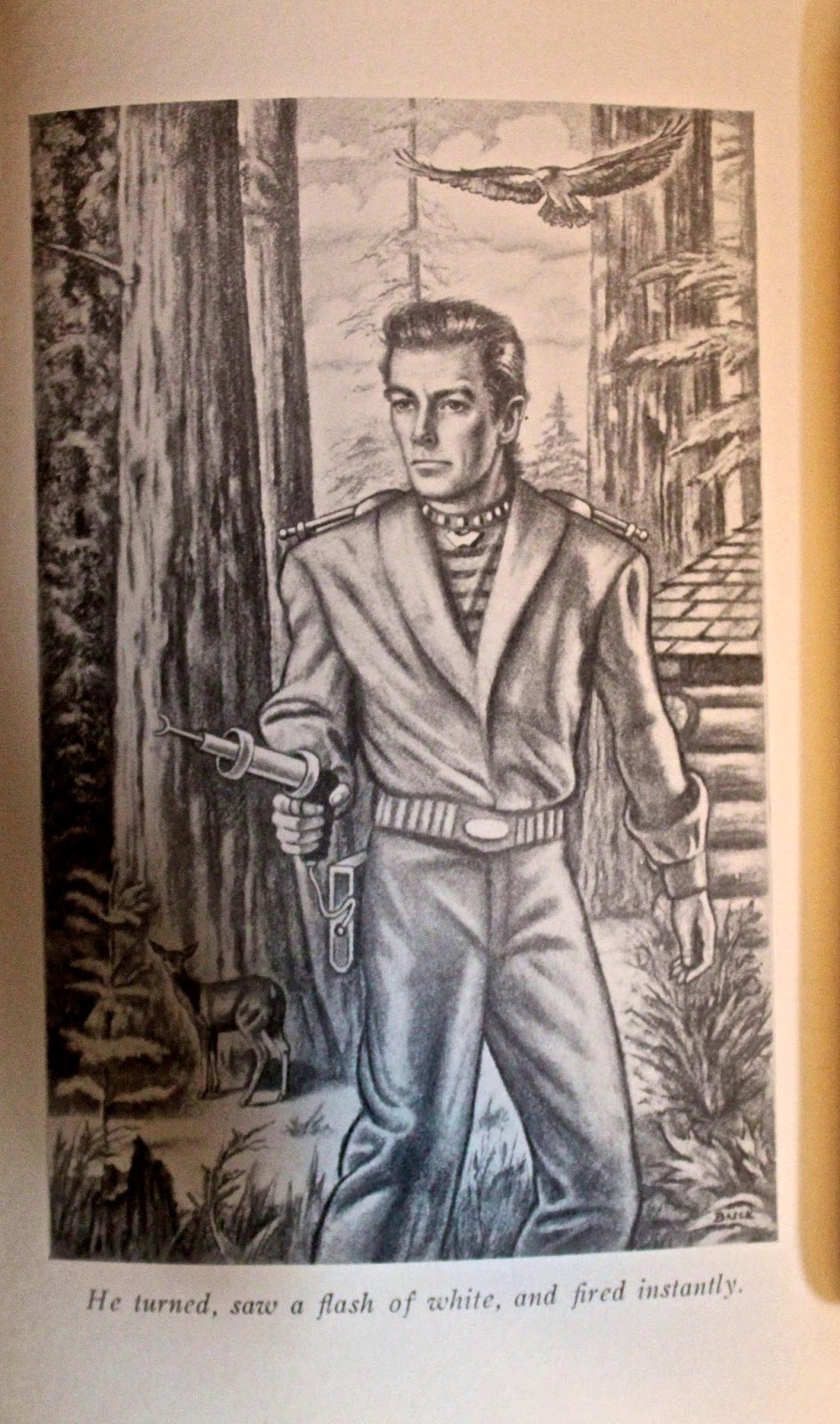
Fantasy Press, 1948, Illustrated by Robert Beck, Jacket Design A.J. Donnell
When I began reading SF, in my elementary school library, the collection ran heavily to Winston Science Fiction Novels, and Andre Norton and Robert Heinlein juveniles. My experience certainly agreed with Vinge’s statement below.
" When I first began to speaking to sf groups, I used to take an informal poll, to see what book had inspired people's love of science fiction. Almost invariably, it was either a book by Robert Heinlein or Andre Norton."
"Andre Norton: The Mother of Us All" by Joan D. Vinge
Thus I entered the world of Robert Heinlein with titles like, Rocket Ship Galileo, Space Cadets, Red Planet, Farmer in the Sky, Starman Jones, etc. Eventually I graduated to Heinlein’s less juvenile works, short stories, If This Goes On, Sixth Column, Waldo, They Also Walk Dogs, He Built a Crooked House, and novels the Moon is a Harsh Mistress, The Puppet Masters, Starship Troopers, Stranger in a Strange Land, most of which I loved. But it was with Stranger that Robert and I diverged. It was preachy and for me uninteresting. By then I had meet lots of other SF writers, Van Vogt, Bradbury, Asimov, Clarke and I did not bother with Heinlein’s latter works Time Enough For Love, I Will Fear No Evil, Friday etc. and even then I felt there was something wrong with Farnham's Freehold. So while I would reread my favourite juveniles ( Between Planets, Farmer in the Sky ) I left Heinlein’s more “serious? , adult? mature?” work alone. A few months ago I decided to reread The Moon Is a Harsh Mistress, a book that I enjoyed in my callow youth, what a cool setting and society, and it was also enjoyed by my geek friends, okay friend, so we could discuss it. I did not finish. I just found the relationships paternalistic, sexist, misogynistic and the philosophy unworkablely libertarian. Don’t like someone, drag them before a kangaroo court of your neighbours and then toss them out an airlock. Yeah that would work, sounds like a totally impartial system. Around the same time I read The Door into Summer, I suggest you read the first part about the cat then stop, and Time for the Stars, okay but in both I found the protagonist’s relationship with young girls problematic. Things like time dilation and cold sleep make for the possibility of some odd coupling in Heinlein stories. And so I have become quite critical of Heinlein’s work over all. Flaws in the juveniles grow more pronounced in his mature work, as though his thinking never really matured. The elements of wish fulfilment seems so prevalent in the later works they read like the fantasies of a male’s mid-life crisis with a very shallow top dressing of plot.


One Heinlein novel I remember finding interesting as a teenager was Beyond this Horizon. So I have decided to look at this novel in some detail to see what initially attracted it to me, what I now find a bit unappealing and what I think it tells us about themes within Heinlein's works. As always I will also mention a bit about my relationship with the work.
Some years ago while on vacation I wandered into the shop of my favourite bookseller, 25 plus years and several moves on his part and I am still buying his books, and spotted the Fantasy Press edition of Beyond This Horizon illustrated by Robert Beck, quite a bit of money later it was mine. Then just before Christmas I received his latest e-catalogue, we have never actually lived in the same city, and there was a copy of the April 1942 Astounding Science Fiction with a beautiful Hubert Rogers cover, for Beyond This Horizon by Anson MacDonald (a common Heinlein nom de plume). If my relationship with Robert is strained I still love the Hubert Rogers covers for his work in Astounding. So after antagonizing about which issues of Startling Mystery Stories I also desperately needed, I pushed the order button.

Cover/interior illustrations by Hubert Rogers
Spoilers
Since I am most interested in discussing the society Heinlein creates and the relationships between characters I will introduce information right away that is only revealed as one reads through the novel. For this reason this entire discussion can be seen as a form of spoiler. I will however try not to give away the whole plot but rather, as I have stated above, look specifically at aspects of the society and characters Heinlein creates that are of interest to me, The novel is set in the future; after the Atomic War in 1970 mankind begins to use genetic engineering to try to breed war out of mankind. This lead to two further wars, one in which the pacifists are wiped out by the non-pacifists and a later war when the government of the great Khan breeds humans using genetic engineering, deliberate mutation through radiation, surgery on zygotes etc. to create insect like castes of sterile human mules for specific occupations including soldiers. They were eventually defeated and the current society took over. This society occupies North and South America and is colonizing the solar system. The only mention of the rest of the world is fleeting, the longest states " The scattered tribes of Eurasia and Africa, fighting their way back up to civilization after the disasters of the Second War" p 112.
The novel begins with our protagonist Hamilton Felix a designer of arcade style games. paying a visit to the office of his friend Monroe-Alpha Clifford a Director of the Bureau of Economic Statistics, Office of Analysis and Prediction. This meeting serves as an excellent introduction to this brave new future. Clifford's job is to run the computers which calculate any surplus in the production-consumption cycle, the economic welfare of this society requires that these two sides of the economic scale balance. (His computers still use punch cards but given the spotty use of computers in early SF I will settle for this.) Each citizen receives an allowance to live on. They in turn can work a shortened week and receive an additional increase. One of the central societal problems seems to be that even under this system production outstrips demand. People are simply too productive, entrepreneurial, and easily bored to sit at home. drinking beer, watching telly and updating their blogs.The central government must therefore decide whether to increase the citizen's allowance, invest in private business proposals or public works projects or invest in research which sadly almost always creates a greater surplus. What to do with this surplus is discussed a number of times in the novel. At no point is there any suggestion that this could be used to assist the barbarians of Africa and Eurasia. Another element that come out of this initial meeting is that both men are carrying sidearms, indeed most men carry needle beams, Hamilton has a 45 colt automatic because he is a bit of a live wire. Why guns you ask? There are so many good reasons. And these will be explained to Hamilton and us over the course of the novel by the next important character we encounter, Morden Claude Director Moderator of Genetics. Morden fills the mentor/father figure role common in Heinlein's work, a few examples being Jubal Harsha, in Stranger in a Strange Land, Sam Anderson of Starman Jones etc. Morden explains "An armed citizenry, willing to fight, is the foundation of civil freedom." p144 or "Well in the first place an armed society is a polite society. Manners are good when one may have to back up his acts with his life. For me, politeness is a sine qua non of civilization. That's a personal evaluation only. But gunfighting has a strong biological use. We do not have enough things to kill off the weak and stupid these days. But to stay alive as an armed citizen a man has to be either quick with his wits or with his hands, preferably both. It's a good thing." p223. Society does have a mechanism by which men can avoid this requirement, drunks, the elderly, cowards? and men on official business like the police can wear a brassard indicating your status as a non-combatant.
What about women, we will get to that. Hamilton meets Morden when he is summoned to Morden's office to discuss the fact that he has, to date shown no interest in requesting help to plan children. The Genetics Board exists to help couples, called Planners, planning to have children. The office ensures parents pick the best possible genes available throughout the fertile period covered by the term of their relationship to create the best possible offspring. Hamilton represents a star line and the Genetic Boards board have a mate in mind for him, his fifth cousin Longcourt Phyllis who Hamilton and Morden's ogle via a stereo screen as she is swimming. But Hamilton does not want to have children, it seems that since childhood he had harboured the secret desire to be an encyclopedic synthesist, one of the true leaders of the world, but Hamilton does not have the eidetic memory necessary. Morden assures him that your children would have it, not only would Hamilton's children have an eidetic memory, but they would also have " something lacking which needs to be added and will be added. I said you were a survival type. You are except for one thing. You don't want children…, But it will be corrected at this linkage. Your children will be anxious to have children I can assure you of that." p. 44 (So much for free will, can the Great Khan be far away) But unconsoled, really!, Hamilton leaves.

ogling Longcourt Phyllis by Robert Beck
The next important, from my point of view, encounter is when Longcourt Phyllis visits Hamilton to meet her potential mate. She is, gasp wearing a gun, something Hamilton takes exception to " What isn't wrong with you? I know your type. Your one of these independent women women, anxious to claim all the privileges of men but none of the responsibilities. I can see you swaggering around town with that damned little spit gun at your side, demanding all the rights of an armed citizen picking fights in the serene knowledge that no brave will call your bluff. Arrgh! you make me sick." p 77. But not so sick that after wrestling the gun away they don't engage in the following romantic interlude. "" Put your face up" she did not. He took a handful of hair and snapped her head back. "No biting," he warned, "or I'll beat the holy hell out of you." ah romance in the old days. But don't worry as Hamilton assures Clifford after Clifford has attempted to shoot his lady love in a fit of misplaced social zeal. "" Women will forgive anything."With a flash of insight he added, Otherwise the race would have died out long ago."" p. 162 Boy, Hamilton and insight that was unexpected.
Below Clifford on a bad day, Gnome Press Edition
One of the more interesting female characters is the one hundred year old cigar smoking, needlework doing, member of the Board of Policy, Madame Espartero Carvalac who is similar to the pragmatic no- nonsense character of the grandmother Hazel Douglas in The Rolling Stones so maybe longevity helps women earn citizen status in Heinlein's mind.
So what did I like about the book initially, probably the guns, I was/am a Louis L'amour Fan. Also the attempt at creating a society with the four hour day, flying cars, space travel etc. that we were being promised in the 1960's when I read it. The ideas seem even more interesting now when we contemplate, negative income tax, flat taxes, the declining middle class, the EU and all the different economic challenges we face in a heavily automated global economy. Certainly the revolt, quickly scotched, would have attracted me although on rereading I was surprised at how much of the book was set after the attempt to over throw the government.
On rereading one of the most prophetic parts was this description of the entertainment at a large party, " Two theatres were available, one of which was giving a continuous performance of all the latest and smartest stereo-reels. the other provided the current spot news for anyone who could not relax without knowing what was going on out of his sight." p.60.
Hubert Rogers for Astounding Science Fiction


