" In this universe the night was falling; the shadows were lengthening towards an east that would not know another dawn. But elsewhere the stars were still young and the light of morning lingered; and along the path he once had followed, Man would one day go again"

Arthur C. Clarke Against the Fall of Night
Showing posts with label nuclear war. Show all posts

Sunday, March 24, 2019

Vintage Science Fiction on DVD (Weird Tales, Pt. 1)


Some time ago I mentioned I had purchased a DVD containing old issues of Weird Tales magazine. I thought the product was reasonable and enjoyed the stories so I purchased some more DVD's of classic titles such as Amazing, Astounding and Wonder Stories. I am also considering adding other titles such as New Worlds and Nebula Science Fiction. I have always enjoyed reading older science fiction with all it drawbacks not the least of which are, misogyny racism, and homophobia (and bad writing). But misogyny racism, and homophobia are everywhere, even today. I am capable of separating truth from lies, and I can read without accepting stereotypes and hate speech. Possibly my reading even gives me a greater understanding of how such ingrained attitudes are perpetuated in our society, but that sounds like a very pompous and self serving claim. I read early science fiction because I enjoy it. What positive elements do I find in these very pulpy stories? I recently found a post by my favourite criticMichael Dirda that captured some of my reasons. He is talking about mysteries, but I think it holds true for my reading of science fiction as well.

"By the time Inspector Richard Queen and his bookish son Ellery arrive at Manhattan’s Roman theater to examine the dead body of crooked lawyer Monte Field, I was registering a distinct sense of well-being and contentment. Here was a classic Golden Age puzzle — Ellery Queen’s first case, in fact — and virtually all the characters were caricatures, the dialogue was stilted and corny, and the elaborate plot verged on the ludicrous. What more could one ask for?

That sounds paradoxical, but artificiality is a welcome attraction in many vintage who-and-howdunits. The stories deliberately leave out the messiness of real life, of real emotions, thus allowing the reader to mentally just amble along, mildly intrigued, feeling comfortable and even, yes, cozy."

https://www.washingtonpost.com/entertainment/books/stilted-dialogue-a-ludicrous-plot-on-the-pleasures-of-the-vintage-whodunit/2018/11/13/eaaf5122-e761-11e8-bbdb-72fdbf9d4fed_story.html?utm_term=.9b544948ead2


I am also interested in how people at the turn of the century, the 1920's 1930's etc. incorporated the tropes of science fiction into their stories, elements like, future war, time travel, space travel, scientific advances, societal change, technology, and environmental degradation. I like to see how these ideas move through the science fiction stories that come after them. I am also interested in how real events bleed over into science fiction, the great depression, the various wars, atomic power, free love, the rise of computers etc. I like to read, ruminate and reflect, it keeps me out of trouble and mildly entertained.
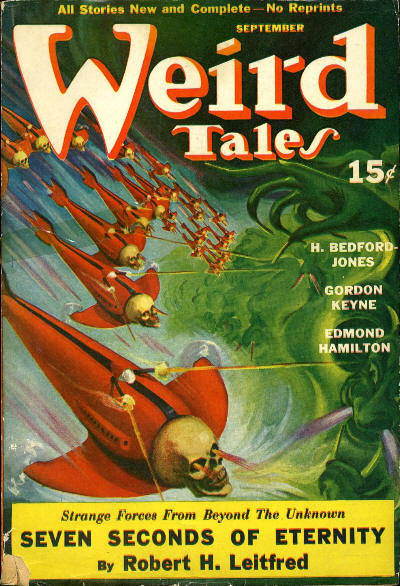


Weird Tales, September 1940, cover by Ray Quigley. Let's be honest, I choose this issue because I was seduced by the, skull headed planes. If this illustration was indeed for Leifred's, "Seven Seconds of Eternity", I have to asume it is only a symbolic representation of events. The cover image was taken from the ISFDB, the interior illustrations are by Harry Ferman.


The story starts in New York, the year is 2001. The city is quiet, moving sidewalks have replaced subways, cabs and private vehicles and the turbines powering the city are underground. The world has been at peace for two months, following ten years of war. The war ended with the sudden death of Marshal Huen Feng Zaryoti, in his headquarters plane seven miles above San Francisco. " Zaryoti might have won that lightning war against North America had not a combination of forces set in motion by a young scientist, working with difficulty against the bureaucracy of government, found a way to combat the world's most deadly weapon-the atomic bomb." (5) I wanted to mention two things before I proceed. First I intend to cover two Weird Tales stories in parts 1 and 2 of this post and both feature some mention of that favourite trope of genre fiction of the period, the" yellow peril". I could discuss this in detail but I think at present I will simply provide a link to the topic at The Encyclopedia of Science Fiction. Marshal Zaryoti doesn't really figure in the rest of the story and basically the plot just needed someone to provide an enemy force in the war.

http://www.sf-encyclopedia.com/entry/yellow_peril

The second item that interested me was the mention of the deadly atomic bomb is a story from 1940. Much has been made (a lot of it by John W. Campbell) of the government's reaction to atomic bomb in the 1944 story "Deadline" by Cleve Cartmill that Campbell published in Astounding. While the bomb in "Deadline" was described in detail, it is interesting to note that the concept was alive and well in science fiction years before the Cartmill story. Wikipedia has a nice discussion of the controversy around "Deadline" here.

https://en.wikipedia.org/wiki/Deadline_(science_fiction_story)


However our focus now shifts to the young scientist Arron Carruthers, having defeated not just Zaryoti but also a stifling government bureaucracy, he should be happy. But a strange mood was on him, he felt all was not right with the world. "He was troubled and a little afraid. Nature, he knew, was never wasteful. Only man threw things away and forgot about them after afterwards. And nature sometimes reclaimed this waste to man's sorrow." (5)

For the stories I pull from the DVD's I will include spoilers, since I want to discuss them in some detail, and I suspect most people will not be reading them anyway.

And indeed Carruthers was right, for ten years man had not only released the toxins from vast explosions but also the smoke from incendiary fires and wastes released from the vast munitions factories built by both sides. All this material has formed great clouds above the earth. Eventually these clouds release a deadly ash like snow that kills everything it encounters. The government reluctantly consults Carruthers, because well be is smarter than them and they feel insecure. He discovers that in one location the clouds have been dispersed by a meteorite, and convinces the government to send up 20 planes to seed the clouds with fragments of meteors. Everyone on the air crew dies because, well not all meteors contain the same elements. Something my collection of How and Why Science books could have told Carruthers, had he looked it up.

Carruthers does manage to isolate the active ingredient but faces two problems, no one in Washington wants to hear from him, and the element is unique to the sample he has and is much too small to be of any use. But Carruthers has the answer, he has Carborlium "Carboralium is a peculiar metal with a powerful affinity for any metal it is brought in contact with." (19) By exposing bars of it to the Neutronium in the meteor they can create all of the material needed to destroy the clouds. However the amount is the meteor is infinitesimal, the only way to place the Carborlium next to to Neutronium is to shrink to the subatomic level, so small that a wandering electron would appear to be moon. Carruthers enters the meteor with George Vignot a fellow scientist and Langham the government's Chief of Intelligence. They are to remain in the subatomic world for no more that seven seconds of Earth time, however time will pass at a very different rate where they are.

So now we have yet another science fiction trope, the alteration of scale as The Encyclopedia of Science Fiction in their entry "Great and Small" calls it. It is a trope I enjoy and intend to cover in a longer post. I have read a number of stories of this type from The Girl in the Golden Atom by Ray Cummings, to The Land of Dreams by James Blaylock, and I am currently reading "The Diamond Lens" (January 1858 Atlantic Monthly) by Fitz-James O'Brien. Looking at the entry below there are lots more waiting for me, and I have to say that the first story I read in my Amazing DVD also dealt with the alteration of scale. I have to admit I did not expect it would be part of this story when I started reading, but that was part of the fun of this type of exploration.

http://www.sf-encyclopedia.com/entry/great_and_small

The other thing that I was really surprised with in Leitfred's story was the environmental aspect. I was surprised that someone in the 1940's would discuss the environmental consequences of war, not only the use of but also the production of vast numbers of weapons. If anything I think this was the one element of this story that I will remember, and it was one I wanted to highlight for others.


Tuesday, May 17, 2016

Ontario Trip 3, Stuart Cloete "The Blast"


Congo Song, Stuart Cloete, 1944, Collins, Toronto

This is the final post on the books I picked up on a recent trip to Ontario to visit family. I have to admit my purchase of Congo Song, was based entirely on the lurid cover and the equally lurid synopsis on the back cover. While I could see it falling in line with my interest in gene or pulp fiction the SF element seemed absent. Then I looked Stuart Cloete up join Wikipedia and found the following information.

"Cloete was among the pioneers of the by-now voluminous literary subgenre depicting the aftermath of nuclear war. His 1947 novelette The Blast is written as the diary of a survivor living in the ruins of New York (published in 6 Great Short Novels of Science Fiction, ed. Groff Conklin, 1954)."

Wikipedia also noted that "He was educated in England at Lancing College, a school which at present gives out a yearly prize in his honour to a student who excels in literature and creative writing."

In 1943 Cloete also published a short story called "Congo", which appeared in the anthology Things With Claws, I mentioned this title in my post on horror anthologies with covers by Richard Powers on my HPL blog,


http://dunwichhorrors.blogspot.ca/2016/04/horror-anthologies-and-art-of-richard.html.


I was born in Windsor so a review from the Windsor Star on the back of Congo Song is an added bonus. I did notice editions with a more Harlequin inspired cover by George Meyers for anyone offended by Congo's sailor cap. Having read the two short stories, I suspect I will not read Congo Song anytime soon, if ever.

"Congo"; reprinted from Story Mar.-Apr., 1943 "Congo " seems not unlike the typical scientist goes to the jungle, odd stuff happens tale, that could often be found in early pulp magazines like Argosy, Amazing Stories or Weird Tales. Professor Le Grand, his assistant, our unnamed narrator, and the Professor's young blonde, pregnant wife, Helena Magrodvata, who we are told is of Graeco-Russian extraction have come to Africa to study rubber trees. In due course Helena has a baby boy who unfortunately dies of a snake bite. Helena is inconsolable, on the verge of madness until a female gorilla is trapped by the natives. She is pregnant and Le Grand, who is something of a man of all seasons, he has also been experimenting with a serum against tropical diseases on himself, his assistant and his wife, delivers the baby by Cesarean. Of course Helena immediately decides to raise the gorilla. At this juncture the narrator notes "Again, what did we know of Helena, with her mixed blood, her strong instincts, and her veins full of experimental serums?" (142) Within the year the entire party returns to Brussels and some 8 years pass. The gorilla now named Congo has been raised as a human infant complete with sailor suit. I think we can all see where this is going.

Congo as noted above is pretty typical of the pulp tales of the period, marred by hints of misogyny and racism which would probably become even more intrusive in a longer work. The characters are fairly one dimensional and despite the fact that Cloete is South African the description of Africa lacks the depth of atmosphere we might get in other stories set in exotic locations in works by Rider Haggard, Robert Howard, Henry Whitehead or Jack London.

"The Blast", 1947 original version published in COLLIER'S, April 1946. It is interesting to read a nuclear war story written within a year of the end of WWII. Certainly Cloete, at least for the purposes of his story, saw things very differently that an author writing in the 1960's or 1990's might. " Immediately after the war, an arms race begins, " There was only a state of fear. There were only rumors-stories that Russia and Spain were only a year behind us in the atomic race. These two countries were, of course, at opposite ideological poles and were a constant threat not only to each other, but to the world. "(10) as well there are Nazis in South America, and an ineffectual UN monitoring program that is stymied because countries have begun to produce miniaturized atomic weapons. Our unnamed narrator, a writer of South African descent, living in New York at the time of the blast is starting his record of events some twenty years after the blast. By his estimate the current year is 1972. The actual blast damage he witnessed was quite localized with damage outside the area caused mainly by falling debris or fires so much of the city is left intact. After the initial explosions, retaliatory attacks are launched until the entire world in involved. Shortly after the nuclear attacks, a disease called the Red Death, possibly an out of control bacteriological weapon, wipes out most of the survivors. Now the narrator, a man in his seventies lives alone in New York. The first half of the story is quite interesting. One quibble I would have is that it appears once the bombs dropped a version of prohibition era Chicago appears. "For forty-eight hours, cars roared through the streets and tommy guns spat from the cars." (14) but this chaos ends as the population crashes. The narrator although saddened by the death of his wife, and the fact he ate his pets, a dog and a kinkajou, seems mostly untouched by the demise of everyone else, indeed a cozy catastrophe soon breaks out. The term cozy catastrophe was coined by Brian Aldiss in The Billion Year Spree, when I reread Aldiss’s description in the now The Trillion Year Spree he characterizes it this way “ The essence of cosy catastrophe is that the hero should have a pretty good time (a girl, free suites at the Savoy, automobiles for the taking) while everyone else is dying off.” (316) And except for occasional bouts of loneliness Cloete's New York seems cozy. He has moved to a cave located beneath the Chelsea Hotel for warmth, where he has accumulated great paintings including a Poussin, Renoir, Vermeer etc. books and wine. New York has come to resemble the island in Swiss Family Robinson where every animal Cloete has ever heard of, mostly escapees from local zoos roam freely leopards, tigers, polar bears etc., have all successfully multiplied. Colette obviously has given his world building a lot of thought and he likes lists. There are also mutants, enormous mink five feet at the shoulder and eighteen feet long and gigantic wolves weighing half a ton. Since our narrator likes to hunt he has breed packs of huge dogs that he rules with an iron fist and makes the best it. "Everywhere there are small woods, clumps of trees, and little streams and rivers. There are large numbers of flowers, many of them completely new, at least new as wild flowers. Varieties of roses which usually had to be budded now grow wild, as do gladioli, dahlias, tulips and every other kind of bulb. Hyacinths, daffodils and crocuses cover large patches in solid mats of color; they lie like scatter rugs on the green floor of the city; and nothing more beautiful could be imagined than coming across a great striped Bengal tiger asleep on a carpet of purple crocuses in the first warm afternoon of early spring, or seeing a red and white wild ox standing belly-deep in orange gladioli." (22) It does sound nice, but into this Eden a worm or rather two appear for in our narrator's seventy-third year, he sees two young blonde girls, early twenties actually, armed with spears and mounted on horses, the one animal his New York lacks. He avoids contact but it is the knowledge that he is not the only survivor that encourages him to begin writing down the record of his experiences.

Spoilers and Quibbles.

It is with the introduction of the young women that things really go south for me. They are travelling as part of a all male Native American hunting party in case interpreters are needed. The girls, daughters of the white Indian agent and his wife who died in the blast where adopted by an "Indian squaw". Later a prospector joined the tribe and "instructed the girls in their mother tongue and in his version of history, geography and mathematics. They knew the multiplication tables and could add subtract, divide and multiply-arts which made them valuable to the Indians, who called them in when such obscure calculations were necessary." (59) Our narrator is captured but eventually wins the natives over in part because of his skill with large calibre hunting rifles something they apparently lack the intelligence to master. "I was, faced with an ethical problem. The Indians, who had discovered heavy rifles similar to mine in some of the stores they had entered, wished me to instruct them in their use. I could see nothing to be gained by such instruction, so I tried to explain to them that this was white man's magic and so strong that it had destroyed all the white men in the world but me, turning its forces against them in retribution for their own misuse of its power." (63) When the recoil from one of the rifles breaks the collar bone of a young men they learn their lesson and make our narrator a member of the tribe. This also apparently entitles him to the "girls' who despite having been raised in the tribe since infancy, prefer a seventy-three year old racist jerk to any of the young men they grew up with. I think my problems with the second half of Cloete's "The Blast" are pretty clear. Written in 1946 it treats the Native tribe as first contact savages meeting Columbus or Cortez for the first time, no war veterans here, its all bows and arrows, spears and a few Springfields. In Clifford Simak's A Choice of Gods, the earth is also mostly unpopulated and one of the Native American tribes has returned to a more traditional lifestyle. But this is depicted as a conscious choice, a young woman of the tribe unhappy with this lifestyle is allowed to leave to begin using the last remaining library to further her education. Colette's native's are apparently incapable of learning by observation, the rifle, or picking up concepts like mathematics, content to leave the intricacies of such magical knowledge to whites. There is also an element of middle aged wish fulfilment, Heinlein anyone, and, I suspect, a real fear of racial mixing that insists that the old white guy gets the girl(s).