" In this universe the night was falling; the shadows were lengthening towards an east that would not know another dawn. But elsewhere the stars were still young and the light of morning lingered; and along the path he once had followed, Man would one day go again"

Arthur C. Clarke Against the Fall of Night
Showing posts with label SIMAK CLIFFORD. Show all posts

Tuesday, November 17, 2020

"The Whispering Well" by Clifford Simak

 Our neighbourhood has many little libraries where one can exchange books.  I do partake, although I am better at taking than replacing. I have a large number of books earmarked for them; I simply don't get around to it. (Pause while I fill the backpack for the next walk with the dogs.)  The latest acquisition was a horror anthology, no surprise there, called Dark Forces edited by Kirby McCauley. I approached it as I usually do by reading the introduction. Then I looked for favourite authors.  

Spoilers coming

Bingo a Silver John story by Manly Wade Wellman "Owls Hoot in the Daytime." I had never read this one, and it was not bad. It reminded me of a comment I once heard about Robert Howard's heroes. I can't remember if it came from Howard himself or not. You know that Solomon Kane, Conan or Kull etc., will be captured or surrounded at some point in the story. To avoid a lot of mental gymnastics Howard keeps the mechanism by which they escape simple.  They burst their bonds, hack their way through or are released by a heroine. Silver John has a slightly more extensive tool kit but not by much. There is silver, usually the strings on his guitar, a passage from John  George Holman's book Pow-Wows; or, Long Lost Friend or brute strength combined with pluck and luck.

I enjoyed this, but it did not cover new ground. The third story I read was longer "The Mist" by Stephen King. It might be the first King I have read. I don't read a lot of modern horror, preferring Edwardian or Victorian stories or mythos fiction. "The Mist" is about a group of people trapped in a grocery store by monsters that come through an inter-dimensional rift. The narrator is trapped in the store with his young son. The assumption is his wife, who stayed home, has been claimed by the mist. So you have family stuff and group dynamics. This is pretty everything I dislike in a horror story (yeah there is sex as well so we are covered). In my universe the narrator should be alone or possibly with a few companions. They should be an intrepid polar explorer, occult investigator, unwary academic, luckless tenant, or the doomed beneficiary of a distant relative's largess. If the codicil says burn the book, house, mummy, etc., it is probably a good idea. I may or may not look at King again. So many books, so little time. 

The story I want to discuss is "The Whispering Well" by Clifford Simak. Thomas Parker is a professional non-fiction author. His recent books include works on palaeontology, Egyptology, ancient trade routes and folklore. As the story begins, he has been summoned by an eccentric but well-off aunt to write a family history. He agrees, and the story then jumps to his last stop. He is visiting the site of the farmstead of Ned Parker who settled there after the Civil War. This location became Parker's Ridge. It was not the best land available, but there was timber and a stream for hunting and fishing. Ned was worried, however, that the stream might dry up and had a well dug. The water table was so low that a huge windmill was installed to raise the water, and the whistling well was born. The locals say the ridge and the well has a "bad reputation" but can supply no specifics. However, Thomas feels a certain attraction to it and drives up to spend a few days in his camper. He immediately finds gastroliths, the gizzard stones of a dinosaur. All the time spent in museums has come in handy. There is a problem, however, because there is an undecipherable symbol engraved on it. After examining it closely, Parker comes to believe the engraving dates to the same period as the dinosaur which swallowed it.  There are also huge shapes that move around in the dark beyond his campfire, and he begins to feel uneasy. He remembers a discussion he had with an old black preacher while researching his book on folklore. The unnamed preacher talks about an ancient evil, one that predates our belief in the devil. An evil that predates humanity itself. ( Here, the story is marred by the typical racism of the genre/period) " You white folks don't know. You don't feel it in your bones. You're too far from the jungle. My people, we know. Or some of us do. We're only a few lifetimes out of Africa." (221)

I will insert a plug of Lost Kingdoms of Africa, details here, 

https://www.athenalearning.com/lost-kingdoms-of-africa/

While this passage is jarring today, I loved the concept that Simak introduced. "You're saying that there was evil before man. That figures of evil are not man's imagining?" (221) Here I think, Simak is not talking about the evil men do, but the archetypes that inform our concept of evil or rather the supernatural. His work often contains trolls, ghosts, banshees, and the devil himself. See The Goblin Reservation or, better yet, Out of Their Minds


This story is typical Simak with rocking chairs, a lone protaganist and a farm on a timbered ridge overlooking the river. But even more, large parts of it seem drawn from Simak's own life. 

"He walked the ridge, so high against the sky, so windswept, so clean, so open, so far-seeing. As if the land itself, the soil, the stone, were reaching up, standing on tiptoe, to lift itself, stretching toward the sky. So high that one, looking down, could see the backs of the hawks that swung in steady hunting circles above the river valley." (209) "The Whispering Well"

"This stems, I would suspect, from my boyhood, which was spent in the rural areas of southwestern Wisconsin. The impression made upon me by that country has stayed with me throughout my life. It is a picturesque country, with great high hills, deep wooded ravines, a couple of good sized rivers, the Wisconsin and the Mississippi, and any number of smaller streams running down almost every hollow or valley. As a boy and young man I hunted the hills and fished the valleys and was never  happier than when tramping through the woods. There was a peace and an understanding there I have found nowhere else." (64) Clifford Simak interviewed by Paul Walker in Speaking of Science Fiction

Parker and Simak have both produced non-fiction books on similar topics. I have three of Simak non-fiction titles here, he also published Prehistoric Man (1971), which is both outdated and expensive on ABE. Since I have several shelves on hominid evolution, I have given it a pass.  


I had posted this here because I see Simak as primarily a science fiction writer; that said, the Horror Writers Association made him one of three inaugural winners of the Bram Stoker Award for Lifetime Achievement. I enjoyed this story. It has all the right elements for me, a lone bemused protagonist, existential angst, revelations out of deep time, dinosaurs and a certain amount of H.P.L. cosmicism. In my earlier post on Ray Bradbury's The Halloween Tree, I stated.

"And I realize now it had continued to be my life. Reading Bradbury, I understood that the things that interested me as a child are largely the things that interest me today. I still love rocket ships, dinosaurs, and books with mummies, witches and werewolves on the cover." In Simak work, I again find an author who speaks too many of my lifelong interests. I do wonder, as I have with several other Simak's works whether he could have done more with this concept. But that is probably best discussed in another post.

I will be revisiting "The Whispering Well" again sometime soon. 

Cover credits;

Dark Forces jacket design by One + One Studio

Gobin Reservation by Gray Morrow

Out of Their Minds by Richard Powers

The Solar System jacket design by Joan Wall

Trilobite, Dinosaur and Man jacket design by Mina Baylis

Wonder and Glory jacket designby Angela Pozzi 

Sunday, October 13, 2019

Installment Plan by Clifford Simak

picture
  As I mentioned in an earlier post, I declared The Summer of Simak, collected some materials, and then made very little progress. One problem was that I did not initially know where to start. Then when, how much reading, research and writing should I do in preparation. I could not blindly jump in, could I? I have read Simak all my reading life, but only touched a portion of his oeuvre. I only remember a much smaller subset that I could hope to cover without extensive rereading. After looking at what I have read, what I remember. I began to ask myself have I read critically enough to do Simak and any potential readers of my blog justice.

I considered doing, or claiming, to do a close reading of Simak whatever that means. So I looked up some online lesson plans on close reading, and two things occurred to me. I do not know enough about literary analysis to know if Simak’s works lend themselves to this approach or if I could do a credible job. It also reminded me of the sterility of the university English courses I took where the significance of the work paled when faced with the great amorphous mass of scholarship that already existed, even more importantly, what the professor thought of it. Eventually, I realized that the whole accretion of theory, existing criticism, literary schools, both political and sociological, and personal bias meant that reading the actual work and forming an impression of it would hinder me in the course. I did not want to travel that road yet again,

I chose Simak because I like his work, or lots of it and posting about it forces me to approach the work on a deeper level. A bit of research, some middling thought and an attempt to read more of his work systematically seem to be good enough goals for my advancing years. I am still reading Simak and science fiction, in general, to see different perspectives, to experience fictionally, different realities. I read it to participate in the author’s thought experiments about the future of technology and humankind in general. I also seek wonder and to be entertained. Possibly, occasionally, something I read may even change me or my opinions in some fleeting way. Reading and writing about the works of Clifford D. Simak will be, in my mind, a labour not of scholarship but love.

One step I took was to buy all 12 volumes of The Complete Short Fiction of Clifford D. Simak. As the Black Gate website notes when discussing the first volumes.

"All three, like all six volumes announced so far, are edited by David W. Wixon, the Executor of Simak’s Literary Estate. Wixon, a close friend of Simak, contributes an introduction to each volume, and short intros to each story, providing a little background on its publishing history and other interesting tidbits."

"As a special treat the first volume, I Am Crying All Inside, includes the never-before-published “I Had No Head and My Eyes Were Floating Way Up in the Air,” originally written in 1973 for Harlan Ellison’s famously unpublished anthology Last Dangerous Visions, and finally pried out of Ellison’s unrelenting grip after 42 very long years."

https://www.blackgate.com/2015/10/14/future-treasures-the-complete-short-fiction-of-clifford-d-simak-volumes-1-3/

It appears there might be a couple more volumes in the future. I have found Wixon's introductions quite useful. The introduction to each volume looks at another aspect of Simak' s work, for example, his westerns, his non-fiction books, etc. 

I think overall this project (like my stalled look back at Frank Herbert) will take much longer than intended. But let's get started. Despite planning this project for some time, I have chosen to begin with three stories that were not in my plans, none of which I had read previously. (I read them and they basically self selected) I had planned to start with his novel Cosmic EngineersHowever, taken together, these stories do provide a good overview of trends and outliers within Simak's work. I will cover the first "Installment Plan" in this post. Discussions of "Worlds Without End"  and "The World That Couldn't Be" will follow.

"Installment Plan" first appeared in Galaxy Magazine, February 1959. (cover by Emsh, interiors by Wallace Wood ) It also appears in I Am Crying All Inside and Other Stories vol. 1 of the Complete Short fiction series. 

Steve Sheridan is the supervisor of a crew of robots on a trade mission to Garson IV. Garson IV was first visited by staff from Central Trading 20 years ago. At that time they discovered a tuber with medicinal properties. 

"From the podar, the tuber’s native designation, had been derived a drug which had been given a long and agonizing name and had turned out to be the almost perfect tranquilizer. It appeared to have no untoward side-effects; it was not lethal if taken in too enthusiastic dosage; it was slightly habit-forming, a most attractive feature for all who might be concerned with the sale of it. To a race vitally concerned with an increasing array of disorders traceable to tension, such a drug was a boon, indeed. For years, a search for such a tranquilizer had been carried on in the laboratories and here it suddenly was, a gift from a new-found planet." 

"Installment Plan"

A second expedition encouraged the Garsonians to raise podar and to store it, for some reason, in red New England style barns. Central Trading then spent years trying to synthesize the drug or raise podar on planets they control. They have been unsuccessful so Sheridan has been sent to trade for the crops that have been stored. However the expedition gets off to a rocky start. One of the cargo floaters crashes damaging a number of the robots. This accident introduces two elements. One is robot names in Simak's stories.

In Vol 6 New Folk's Home Wixon discusses how Simak often uses biblical names for his robots. "Two aspects of the names Cliff used will certainly be familiar to his readers. First, many—though not all—of his robots bore biblical names: Nicodemus, Ezekiel, Gideon, Abraham. "

Here we have a Hezekiah, Gideon Lemuel and Abraham etc. there is also Maximilian and Napoleon. 


Also Sheridan has a number of transmogs which allows him to reprogram the skill sets of the robots, (their base personality does seem to remain the same). This become quite important when a cargo sled crashes damaging a number of the robots. To repair the damaged robots Sheridan equips three robots with roboticists transmogs. Other transmogs that we encounter or that are mentioned are spacehand, missionary, semantics, playwright, public speaker, auctioneer, lawyer, doctor etc. Indeed the robots handle most of the work including planning for the mission. However Sheridan notes robot crews have demonstrated in the past that they cannot operate successfully on their own without at least one human supervisor. That said robots are crucial to mankind's expansion into space.

"no ship that could carry more than a dribble of the merchandise needed for interstellar trade. For that purpose, there was the cargo sled. The sled, set in an orbit around the planet of its origin, was loaded by a fleet of floaters, shuttling back and forth. Loaded, the sled was manned by robots and given the start on its long journey by the expedition ship. By the dint of the engines on the sled itself and the power of the expedition ship, the speed built up and up. There was a tricky point when one reached the speed of light, but after that it became somewhat easier—although, for interstellar travel, there was need of speed many times in excess of the speed of light. And so the sled sped on, following close behind the expedition ship, which served as a pilot craft through that strange gray area where space and time were twisted into something other than normal space and time. Without robots, the cargo sleds would have been impossible; no human crew could ride a cargo ship and maintain the continuous routine of inspection that was necessary." 

"Installment Plan"


 The real problems occur when Sheridan and his crew attempt to trade with the Garsonians. Despite the fact that there are fields of what appears to be podar the natives deny they grow it any longer. They also claim that the barns, which are sealed are empty. Crews on trade missions are forbidden to use any violence against native populations so breaking into one is not an option. Sheridan and the robots do note changes from the observations of previous expeditions. The native villages are unkempt, once described as happy go lucky the native seem stressed, tired and generally unhappy. They obviously want the items on offer but will not trade for them.  The robots then come up with a number of strategies to attempt to change their minds including stand-up comedy and medicine shows but are unsuccessful. The mystery when solved is not a happy one. 


This was a great place to start my review of Simak for a number of reasons. One there was more of a focus on an alien planet and culture that I normally associate with Simak whose stories often seem Earth based even when interstellar travel occurs. Also Simak treated us to a science fiction trope, the trader in space that is common in the work of other authors but not necessarily in his. In his introduction to the story Wixon notes that when it was submitted to Galaxy the editor Gold,  

"sent it back for revisions, but he also suggested that Cliff make a series of it and pledged himself to buy the series. Cliff did revise the story, and then started plotting a second “robot team” story—at which point Gold returned “Installment Plan” for more revisions, which Cliff provided within a week. But Cliff’s notes give no hint that he ever again thought of returning to the second tale. I like this story quite a lot, and it puzzles me that Cliff apparently did not … but then, he was not one to indulge in sequels." 

Intro to "Installment Plan", I Am Crying All Inside: And Other Stories 

Given how popular stories of traders in space, see Isaac Asimov's Foundation novels or Poul Anderson's Nicholas van Rijn stories for two examples it is interesting that Simak did not pursue this opportunity. 

We can also see how uninterested Simak is in detailing how technology like FTL travel is achieved. The description of the propulsion of the cargo sleds may actually be the longest explanation I can remember Simak providing in any work I have read.

Also we get a very robot focused story. Given the significance of robots in Simak's work I was really interested in how they were presented in this story. My plan is to discuss robots in Simak's work in a series of general posts on topic. As this post is running long I will only make some general observations. In the first post on this blog I discussed Simak's "All the Traps of Earth" (1960) in this story the robot Richard Daniel develops special powers as the result of traveling through space on the outside of a space ship.


The robots here simply seem to handle it was a normal part of their duties. I think this is important more because it demonstrates that while the robots Simak has created are often similar, domestic servants are common, I don't think their attributes are necessarily consistent from story to story. 

At present I would say the robots in "Installment Plan" are the most human of any Simak presents. They actually argue with and tease Sheridan as human coworkers would. They gamble as a form of entertainment, something I want to look at in more detail in another post. Two are critical of what one would assume is the rather basic spacehound transmog, Ruben says tired he is of it, while Lemuel notes how limited it is. One thing that just occurred to me (sorry)  is that all the robots I remember from his stories seem to be identified as male. So in future reading I will try to understand what role if any gender plays in Simak's robots.  

Friday, July 19, 2019

July 2019 and A Simak Summer


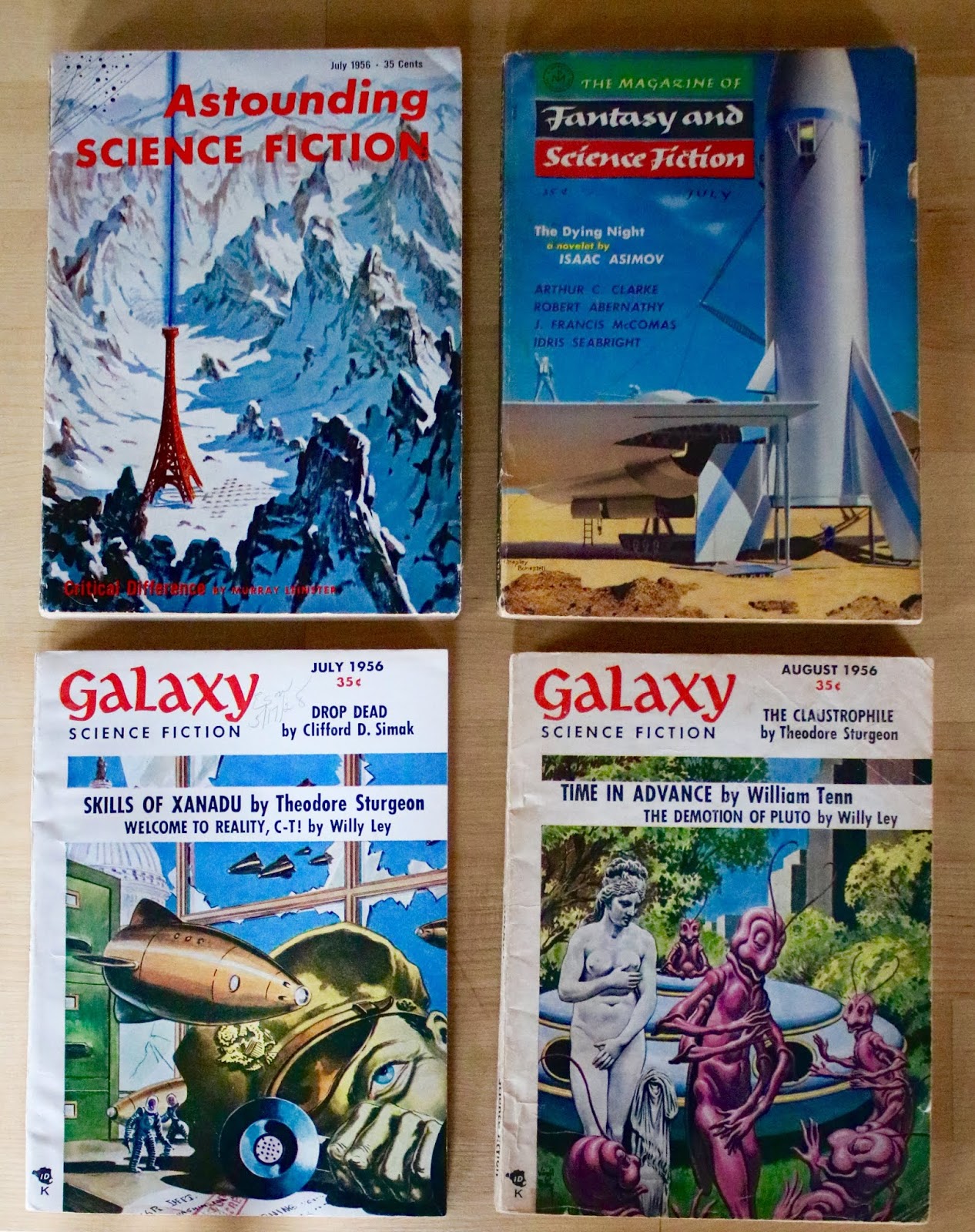
I am a terrible procrastinator, so every summer I surround myself with art supplies, carving tools, and books and magazines to read. I accomplish none of it. I have also set goals this summer I decided to read 3 digest magazines representing the major science fiction titles Galaxy Science Fiction, Astounding Science Fiction and The Magazine of Fantasy and Science Fiction. All are the July 1956 issues, so I can see how the contentts, authors, themes, etc. differ. At the last minute I picked a couple more 1956 Galaxy magazines, cool covers after all. I did not look at the ToC first, so they were not cherry picked in that respect. I am not sure if I will read them cover to cover. I am already way behind so we will see. 


The second project, that is even more behind is A Simak Summer. In my youth when I began reading science fiction, the so called big three were Heinlein, Asimov, and Clarke and I read them all. But I also had another big four that were equally important to me, Andre Norton, I am firing my Norton blog back up there is a link on the right under My other blogs. 


John Wyndham, I am sure we covered some of his books in school but it’s foggy. I read much more of his work than was required because I enjoyed it. Ray Bradbury whose stories are still with me. And last but not, as they say least, Clifford Simak. I have read many of his novels and short stories.

Collecting different editions and appearances of his work has also been one of the focuses for my mania(?), which sees me with way too many books.  Open Road is publishing his complete short fiction, I think it runs to 12 volumes, so there is a lot of material to cover. I have included a link in part because of the crazed look a younger Simak has on the author photo.

https://openroadmedia.com/contributor/clifford-d-simak/

Simak is also an author Doug and I often discuss in our weekly talks, so it seems doubly appropriate. Simak’s story was “All The Traps of Earth” was also the first story covered on this blog. Given Simak’s recurring use of autumnal settings and imagery maybe the series should be called Simak the Autumnal Man, but whatever. With luck the series will run for years regardless of the season. 


Now I am off to put together a post on our friends the Franklin's Ground Squirrels, which will appear here, and at least demonstrate that I do complete some posts over the summer I include the link.

http://thatsjustthewildwood.blogspot.com/

Then I have some reading to do.


The first illustration is by John Schoenherr, for Clifford Simak's "New Folks Home" Analog Science Fact - Science Fiction, cover by Van Dongen


Astounding Science Fiction, cover by Van Dongen

The Magazine of Fantasy and Science Fiction, cover by Chesley Bonestell

Galaxy Science Fiction,1956 July cover by Jack Coggins
August cover by Virgil Finlay
April cover by Emesh

Sunday, April 14, 2019

Robots


  My buddy Doug sent me a clip of this advance in robot locomotion. 10 years of progress in Boston Dynamics robotics GIF.

https://gfycat.com/dapperdamagedkoi

  
I have to admit I found it somewhat frightening. My comment to Doug was, "Pretty cool I would feel even better if I did not think it was probably designed to kill me in my bed. Too much SF, maybe." Doug suggested that I would hear it coming. All the more reason to allow all three dogs to sleep in the bed, (like they would move anyway). But hearing it coming and doing anything about it will, I suspect be two very different things.


  I have been thinking about robots a bit, in part because they appear in so much of the science fiction art I see, in part because they were a huge element in the first science fiction I read. 


  Asimov's robots were my first memorable introduction. But they were constrained, we hoped, by the 3 laws. Then there were lots of robots, good bad and indifferent, but for me the next really memorable robots were Simak's. 


They were everywhere, often as domestic help. Jenkins in City looks after the dogs, Richard Daniel in All the Traps of Earth is a servitor who has outlived his owners, Elmer in Cemetery World is a free robot who earned his living as a construction robot. Then you have the superseded robots who have adopted earthly religions that men have mostly abandoned, Simak must have liked this idea, they appear in in a number of this novels including Project Pope and A Choice of Gods.


But mostly they seemed to have entered domestic service. As this cover for Special Deliverance featuring a tea making Jurgens can attest. 

Jack Williamson in the story "With Folded Hands" indicated the even well meaning robots could go bad, but let us not go there for now.

Jurgens' shape above, was the robot shape I expected, bipedal, head, two arms, two legs, pretty much us in armour with a couple flashing lights.

Some even acted like us.


The first ones we got, in my home town of Windsor were not metal us, but basically arms with tools grafted on. They could not move freely or communicate, they didn't even have heads or legs. They could only perform simple repetitive tasks and violate, a cynic might say, all three laws.

This idea of robots and machine culture in general has progressed of course with golems, drones and AI's getting citizenship in Bank's Culture or Asher's Polarity series. And Well's Murderbot does seem to blur the line a bit, human? machine?, though we all love her and wish her well.


Inhuman robots are still scary. They can really push our buttons.

Which is why I absolutely loved this CLARKSWORLD cover "We are the Robots" by Waldemar Kazak.


Any robots in your life?

Cover Credits;

Caves of Steel, Pyramid (1962) cover by Ralph Brillhart


I, Robot, cover by Robert E. Schulz


"Aesop", Astounding (1947) cover by Alejandro
Project Pope, cover by Rowena Morrill

A Choice of Gods, (1972) cover by Michael Hinge, you can tell it was the 70's I had shirts with these colours like this, sigh.

Special Deliverance, cover by Micheal Whelan

The Magazine of Fantasy and Science fiction, one of Mel Hunter's Lonely Robot covers, but in this one he has a friend.

The Case Against Tomorrow, cover by Richard Powers

City, (1958) cover by Ed Valigursky, possibly the king of robot illustrators for this period.

Sunday, November 30, 2014

ALL THE TRAPS OF EARTH - CLIFFORD SIMAK


I have been planning this blog for some time, and had compiled a short list of titles that I might use for my first post. Then out of left field I read and became intrigued with La Befana by Gene Wolfe, but that all went by the boards when, in searching for quotes for my blog, I came upon the quote from Simak's All the Traps of Earth (remember the magpie mind in my introduction). Since I am a huge Simak fan and knew I had a copy, I was off. I have,  mainly read his novels, so this was my first reading of this story.

The story begins with Richard Daniel, the 600 year old robot servitor of the Barrington family, who, with the death of the last member of the family, is compiling a list of possessions to be auctioned, including himself. The law states that all robots will have their memories erased every 100 years. As an influential family the Barringtons have avoided this erasure, and Richard Daniel has 600 years of memories. Having consulted both a lawyer and a minister, neither of whom can offer any alternatives, Richard Daniel is desperate. Refusing to submit to what he perceives as the destruction of his personality, Richard Daniel dons human clothing, another  crime, and  heads for the spaceport.

This story was published in the Magazine of Fantasy and Science Fiction in March 1960. Despite its publication date this story has many of the tropes that first appeared in Simak's stories in the mid 1940's culminating in his fixup novel, City published in 1952 by Gnome Press. These themes continue to appear in his novels in the 1970's and 1980's. You have the multiple generations of one human family, A Choice of Gods (1972), robot domestics, the tea making Jenkins in Special Deliverance (1982), and you have dogs lots of dogs. At the end of the story Richard Daniel embarks on his new life, " a golden afternoon of a matchless autumn day, with the dog trotting at his heels. Another thing I have not mentioned is that Simak, like Ray Bradbury, is considered a pastoral writer and the image of the perfect autumn afternoon, which will probably be the subject of another post, appears in many of his works, often as a setting for the spiritual regeneration or recharging of his characters. Having said that this story treads familiar ground, is there anything to recommend it? I do think that if you want to be introduced to Simak's work this is a very good start. The novella, The Big Front Yard (1958 Hugo winner), and the novel, Way Station (1963 Hugo winner), are probably his best work, but All the Traps of Earth is a solid story.

Spoilers

One thing that distinguishes this story in my mind is that Richard Daniel is the main character, the mostly unnamed humans are role players or foils. In essence this is a coming of age story, Richard Daniel leaves home and embarks on his voyage of discovery. Unable to get inside the first ship he approaches, he attaches himself to the outside and travels through hyperspace outside the protection of the ship. I am not sure why this matters to a robot? This experience opens him to the wonders of space and time in an almost Stapledonesque experience. 

" Once again the universe was spread far out before him and it was a different and in some ways a better more diagrammatic universe, and in time, he knew, if there were such a thing as time, he'd gain some completer understanding and acceptance of it. 
He probed and sensed and learned and there was no such thing as time, but a great foreverness."

This awakening seems to pass, but as Richard Daniel continues his travels he realizes that he can view ships, robots and men as diagrams or schematics, Soon he learns that he can detect, manipulate or repair certain weaknesses or illnesses. The full extent of his powers are not fully tested within the story. Initially, Richard Daniel considers whether he should use his psi powers, another Simak trademark, to become a robot messiah, but eventually decides to use his powers to augment his normal robotic inclination to help humans.

Simak has fleshed out the character of Richard Daniel far more that his normal robot characters. He is not an Asimov robot; he breaks laws, considers the murder(?) of other robots, and expresses great contempt for the humans who man the second rocket he travels on. 

I am not sure whether it is a strength or weakness that many of Simak's robots seem more like humans in metal suits, than the cold unemotional mechanical servants of much science fiction. It is also interesting that while actual robots began as single purpose mechanisms for heavy industry applications like welding, Simak's are butlers, gardeners and field hands, often little more then vanity objects: unless the world is suddenly depopulated, but that is another post.