" In this universe the night was falling; the shadows were lengthening towards an east that would not know another dawn. But elsewhere the stars were still young and the light of morning lingered; and along the path he once had followed, Man would one day go again"

Arthur C. Clarke Against the Fall of Night
Showing posts with label nostalgia. Show all posts

Wednesday, April 15, 2020

A Medicine for Melancoly (Or: The Sovereign Remedy Revealed!) by Ray Bradbury


  I began reading this story some time ago. Certainly, before our period of self-isolation started. This morning after completing Asimov's "The Winds of  Change", I decided to finish it, possibly because I associate both writers with the first science fiction stories I read. 

Mr. and Mrs. Wilkes have had several doctors attending to their daughter Camilla. None has helped, and finally when the last suggests bleeding her, they drive him off. She tells them she hurts, the list is long, but basically all over. "Since the start of spring, three weeks, I've been a ghost in my mirror; I frighten me. To think  I'll die without seeing my twentieth birthday."  (39) 

Her parents are at a loss; their son Jamie suggests they take her downstairs and set her outside the door. He reasons that someone going by might recognize her condition and suggest a cure. 

"Father?' said Jamie breathlessly. " Have you ever known one single man who didn't think he personally wrote Materia Medica? This green ointment for sour throat, that ox-salve for miasma or bloat? Right now, ten thousand self-appointed apothecaries sneak off down there, their wisdom lost to us!" (40)

When the crowd becomes unruly, Jamie suggests charging them a tuppence for providing a diagnosis. While Camilla's condition remains undiagnosed, the family raises a lot of money to the amazement of Mr. Wilkes. 

"Did you imagine, family, so many people, two hundred, would pay to give us their opinion?" 

"Yes" said Mrs. Wilkes. "Wives, husbands, children are deaf to each other. So people gladly pay to have someone listen. poor things, each today thought he and he alone knew dropsy, glanders, could tell the slaver from hives. So tonight we are rich and two hundred people are happy, having unloaded their full medical kit at our door." (43) The Vintage Bradbury


As is often the case, Bradbury's characters operate with a feverish, almost manic intensity. He has always been a romantic, unfettered by science and the somewhat unconventional solution to their problem is also typical of his work. I enjoyed the story, Bradbury offers some cynical but none the less accurate observations about human nature and our love for offering advice which seem particularly appropriate in our current era of internet charlatans, celebrity "influencers", and pontificating politicians. Also, the mention of ox-salve reminded me of my mother applying horse liniment to my dodgy ankle. The diagrams on the label showing how my fetlocks would be improved by several applications were particularly illuminating. 

Covers:

The Vintage Bradbury ?

A Medicine for Melancholy ISFDB Dean Ellis?

Thursday, March 5, 2020

Books; Gimme Shelter, Ursula the two Rays and me

  I am still a bit melancholy and missing Shaun of course. Experience has taught me this will last for some time. What I do when stressed or depressed, is turn to favourite authors like Louis L'Amour or Dorothy Sayers or special books. Often they are older books, The Wind in the Willows by Kenneth Grahame, Beston's The Outermost House, Annie Dillard's A Pilgrim at Tinker's Creek, My Belief a collection of essays by Herman Hesse. And as you might expect science fiction, authors like Simak, Norton, Clarke, Heinlein (the juveniles) and, of course, Ray Bradbury. Tuesday Helen was going to an appointment, as I knew I would be waiting some time. I decided to take a real book. I have two shelves with display space dedicated to Bradbury. I choose a copy of The Machines of Joy that I purchased a few months ago when I decided to spice up my holdings to reflect how important Bardbury's work had been in my mental landscape. I read four stories while I waited, I may have read Tyrannaous Rex previously but retained little the rest were new to me. In the order, I read them. 


"The Machineries of Joy," set in Chicago, the story deals with some acrimony between priests living in the same rectory. Father Brian is particularly aggravated by Father Vittorini's interest in the rocket launches at Cape Canaveral. He is also unhappy that Father Vittorini has been up watching them half the night on the television set, of which he also disproves. A second Irish priest Father Kelly is less dogmatic but sides with Father Brian when Father Vittorini produces a newspaper clipping in which the Pope blesses the space program. Eventually Pastor Sheldon, he is also Irish, but born in California and thus apparently less dogmatic works to broker a peaceful solution. It seems Father Brian and Kelly feels that humanity's expansion into space may make ministering to their flock even more problematic. 

"The Machineries of Joy" is a slight and rather silly story, and possibly the emphasis on the nationality of the priests might offend some readers. I enjoyed the story. The dynamics of the group reminded me of situations I have been in when living in the field with coworkers (archaeology). But in the abstract, this friction was amusing. Also, I felt Bradbury captured both the excitement and uncertainly caused by the space race. By current standards, the story was naive and nostalgic, but that is Ray. I have to admit that when the story begins, Father Vittorini is eating cornflakes, and when we stopped at the store on the way home, I bought some. Nostalgia can be a powerful force.

"The illustrated Woman" is pure Bradbury, set in the world of sideshows and doctor's offices with a large illustrated woman, her tiny husband and a somewhat overwhelmed psychiatrist. Dr. George C George is waiting to meet his next patient when in comes all four hundred pounds of Emma Fleet. Emma starts by telling the doctor her personal story. As a girl, she was always heavier than her friends. Her weight always made her feel unattractive and insecure. Then on a trip to the carnival, she encountered Willy Fleet. He had been travelling with Singer's Midgets for six seasons before taking a position running the Guess Your Weight machine. Willy, it seems, has a secret. He is actually a tattoo artist and in search of a perfect canvas. It's kismet, of course, Willy and Emma fall in love, and they spend many happy years while Willy creates his masterpiece. Lately, however, Emma has noticed some changes in Willy's behaviour, and he has been dusting off the Guess Your Weight machine. Can Dr. George help? The original short story version of, "The Illustrated Man", not the collection, was a very dark tale that first appeared in Esquire (July 1950). Remember, Bradbury started publishing in Weird Tale. This story "The illustrated Woman" was a much lighter tale that still embraced Bradbury's fascination with  carnivals, sideshow performers, strange confessions and the vagrancies of life, love and the human condition.  


"Tyrannosaurus Rex", I am not going to say much about the plot of this story. The protaganist John Terwilliger is a stop-motion animation artist. He is building a T-Rex for Joe Clarence, a horrid Hollywood producer who rides him constantly. Nothing is good enough, cheap enough, scary enough, they also argue over the final ownership of the model. Their disputes are mediated by Mr. Glass, the long-suffering studio lawyer and my favourite character. Another good story. 

I know I read it when I was younger, but I suspect that while I enjoyed it, I did not understand the significance the story probably held for Bradbury. Bradbury loved the movies, collecting autographs at every opportunity and, as an adult, he worked on the screenplay for Moby Dick. He was also lifelong friends with Ray Harryhausen, the great stop-motion artist of films like Jason and the Argonauts, The Beast from 20,000 Fathoms, and The Valley of Gwangi. When I had the opportunity to have Mr. Harryhausen sign some items at a film festival, I brought out Bradbury's A Graveyard for Lunatics, which features a character based on Harryhausen. 


The last story I read that day was "To The Chicago Abyss," which first appeared in The Magazine of Fantasy and Science Fiction for May 1963, which was the Ray Bradbury tribute issue. It is a dystopia. The action takes place in a ruined city. An old man has been accosting strangers reminding them of items that used to be available before the current period of strict rationing. However they now live a police state with laws forbidding all public disturbances. Finally, he is assaulted and then hidden from the police by a stranger. There are obvious hints of Fahrenheit 45i in this work, with its police state and suggestions of bombed-out cities. But what struck me the most was how the protagonist resembled Bradbury. His crime is reminding people of vacuum-packed coffee, and Butterfingers chocolate bars just as in other works Bradbury repeats the advertising jingle Denham's Dentifrice or has a character expound on the virtues of Cream-Sponge Para Litefoot Shoes. Bradbury often comes across as a storyteller almost consumed by his wild enthusiasm for the setting and action of his own stories. Here protagonist shares Bradbury's uncontrollable, nostalgic love of simple pleasures and happier times. 


Wednesday, we went out for another appointment and visited Shelf Life books. I had hoped to find some of the MIT presses editions of Stanislaw Lem's work. They were not to be found. 


However the helpful young man with the wonderful tattoo's, big insects and geometric diagrams, had placed Ursula K. Le Guin's The Lathe of Heaven one of my favourite SF novels among the staff picks by the register. My previous copy is falling apart and I have long wanted the cover with the flying turtles/Aldebaranians. So I have spent part of the evening flipping through it, eating tuna fish sandwiches (p103) and listening to the Beatle's "With a Little Help From My Friends" (p154) and getting by. 

Saturday, October 12, 2019

James Blaylock's Thirteen Phantasms: escapism and nostalgia in science fiction


  Last week I was sitting in my room surrounded by my science fiction collection, wondering what to suggest to Doug as part of our reading project. Doug's taste sometimes differs from mine, as one would expect, but I have made some fairly accurate guesses in the past. A James Blaylock short story sprang to mind. I knew it involved the discovery of a collection of science fiction magazines. A quick search and I had not just the title "Thirteen Phantasms" but a link to its appearance in Omni.


My wife and I are huge fans of the work of James Blaylock and Tim Powers. They are close friends and coauthor stories and share characters like the poet William Ashbless. They appear side by side in John Clute's Science Fiction The Illustrated Encyclopedia. Clute says, " Some think Blaylock has only a remote connection with SF, and should be treated as a weaver of misty myths for New Age readers who like their truths soft, their music ethereal, and their sewage plants on the other side of the tracks. Others think he has a real science fiction understanding of the world. " (203) I would suggest his work comes out the Weird Tales tradition of science fiction that also nurtured writers like C.L. Moore, Ray Bradbury and Fritz Lieber. 

While I had the story in hardcover, I initially read the Omni version. As followers of this blog might guess, the illustration by Robert K. J. Killheffer also enthralled me. 


My version

"Thirteen Phantasms" alternates storylines — the first concerns the main character Landers who is living in a rented house in Southern California. He mentions a wife, Janet, who is no present. I assume she has died. Blaylock's characters often seem to single widowers, which infuses the story with a certain melancholy or bachelors. Either way, this allows them to indulge their pension for kaleidoscopes, stuffed axolotl and spontaneous road trips. He seems to be at loose ends; he does not, for example, seem to work. While speaking to his landlady, he learns that her late husband kept a collection of magazines in the attic. " against the north wall, lay four dust-covered cardboard cartons — full of “junk magazines,” or so Mrs. Cummings herself had told Landers this morning. "The cartons were tied with twine, pulled tight and knotted, all the cartons the same. The word Astounding was written on the side with a felt marker in neat, draftsmanlike letters. Landers wryly wondered what sort of things Mr. Cummings might have considered astounding, and after a moment he decided that the man had been fortunate to find enough of it in one lifetime to fill four good-sized boxes.

Landers himself had come up empty in that regard, at least lately. For years he’d had a picture in his mind of himself whistling a cheerful out-of-key tune, walking along a country road, his hands in his pockets and with no particular destination, sunlight streaming through the trees and the limitless afternoon stretching toward the horizon. Somehow that picture had lost its focus in the past year or so, and, as with an old friend separated by time and distance, he had nearly given up on seeing it again. "

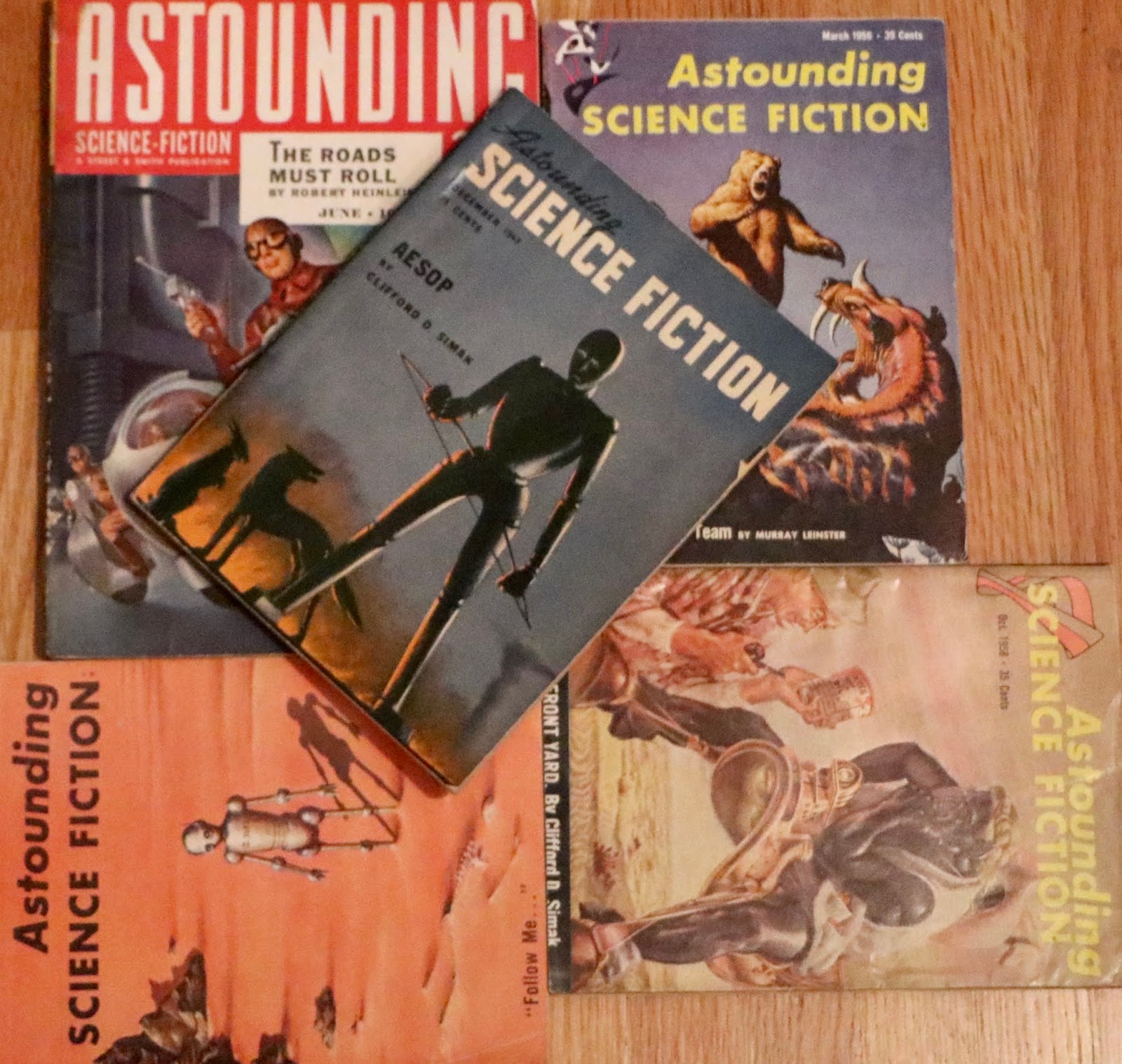
The first issue Landers pulls out is for Dec. 1947, which features one of Simak's City stories, "Aesop", on the cover. 


Blaylock alternates Landers' story with that of a group of science fiction fans, the Newtonian Society, living in Glendale Califonia in the late 1940s. Russell Latzarel is the president, and the group meets at the home of Roycroft Squires. Squires is a bookseller and small press publisher, and it is the small press publications that will link the story of Landers with that of the Newtonian Society. 

"There were book ads at the back of the magazine, including one from something called the Squires Press: an edition of Clark Ashton Smith’s Thirteen Phantasms, printed with hand-set type in three volumes on Winnebago Eggshell paper and limited to a hundred copies. “Remit one dollar in seven days,” the ad said, “and one dollar monthly until six dollars is paid.”"

These magazines have an almost talismanic effect on Landers. After reading “Rain Check” by Lewis Padgett, he goes to the liquor store for the ingredients for the Highball described in the story. He also indulges in a bit of magic thinking mailing a dollar to Squires Press for a copy of Thirteen Phantasms. Later in the story, he will make the one hour trip to Glendale to visit Squires' former home. 


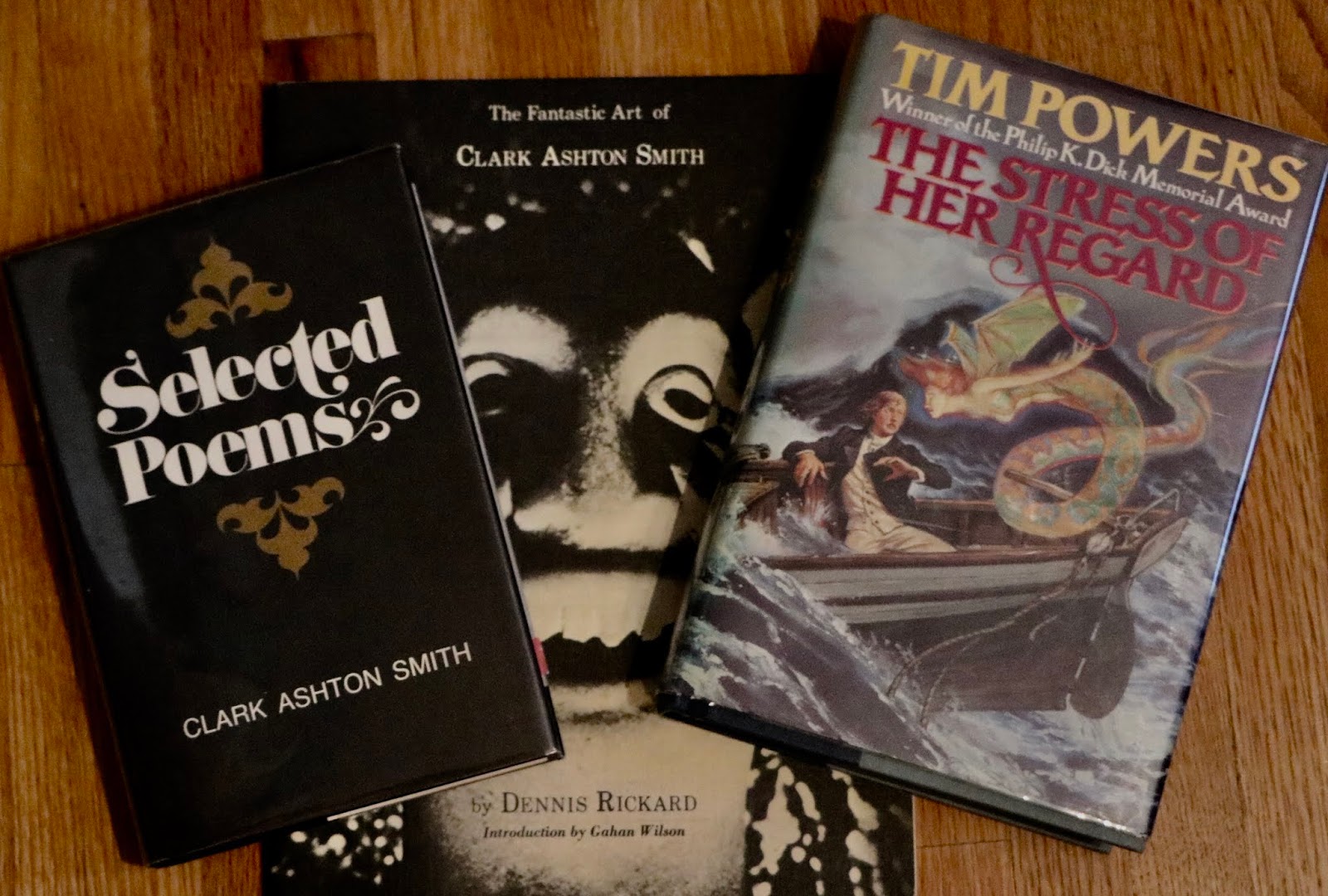
I have attached the link, and I would encourage you to read the story before reading further. Roycroft or Ray A, Squires was an actual fan, bookseller and small press publisher. He was born in 1920 and died in 1988. He was a friend of Ray Bradbury publishing the first edition of Bradbury's story "The Aqueduct" as well as other stories and poems by Bradbury, Fritz Lieber and Clark Ashton Smith. Squires was the literary executor for the estate of Clark Ashton Smith. I think he appears in other stories by Blaylock, but I am my relying on my increasingly faulty memory. I suspect he was a friend of both Blaylock and Powers. The epigraph at the beginning of Power's novel The Stress of Her Regard is from Smith's poem "Sphinx and Medusa". According to ISFDB, this poem only seems to have been published by Squires. While there are lots of Medusa mentioned, I could not find it in Smith's Selected Poems

On rereading it I enjoyed the story. However, the section dealing with the road trip to Glendale and Landers' attempt to get directions at the convenience store struck me. The passages perfectly capture his unhappiness with his life and a certain disconnect almost paranoia when confronted with life in Southern California at the present day. But for me, rereading the story in 2019 drove home both the power but also the danger of nostalgia. As a fictional character, Landers' longing for, in his mind, a more uncomplicated or more comfortable society inhabited by people he will find congenial is harmless. But Canada is currently undergoing a Federal election and many issues I thought we had resolved, topics like race, the environment, indigenous and LGBT rights and the rights of women are suddenly flash-points. Many people seem attracted by rhetoric about returning Canada to some (non-existent) golden age. It is hard for me to read Blaylock's story and not reflect on this. I would suggest that a careful reader can be aware of potential problems with a work without ignoring its' merit. I also do not think authors of fiction are writing autobiography and their work should not always be read as such. I do participate in the world of today, I vote and support causes, I think, are important. But like Landers I also find a bit of refuge in a room filled with science fiction and weird tales, both old and new, warts and all. 

Publisher: Roy A. Squires items published by year.

http://www.isfdb.org/cgi-bin/publisher.cgi?29481

Covers

Thirteen Phantasms by Design Bryan Cholfin Ill. Greg Spalenka

Astounding 

"Aesop" by Alejandro

"The Roads Must Roll" by Hubert Rogers

"Exploration Team" by Emesh

"The Big Front Yard" by Freas

Follow Me by Emesh

The Stress of Her Regard by James Gurney

The Fantastic Art of Clark Ashton Smith The Mirage Press 

Thursday, May 30, 2019

Comfort Reading (Rereading) Roger Zelazny

  I must admit that I am often finding the world is to much with me lately. All the ism's that I thought we had put behind us seem to be returning with a vengeance and the results of each election is as depressing as the last. As someone whose life often has revolved around books and reading I have a constant supply of things I want to read. But every once and awhile some impulse instead points me towards something I have already read, something I know will entertain me without disturbing or challenging me. A version of hiding my head in the sand, maybe, a waste of time I think not. Often I find something new I never noticed or perhaps forgot, maybe the reason I loved it in the first place comes flooding back.  Often I remember the circumstances when I first read a particular title or other books it encouraged me to read. And I do value my mental health enough to give it a little vacation from the world now and then.

Which like Corwin prince in exile, has lead me to Amber. Roger Zelazny has long been a favourite author. I enjoyed the first five Amber books when I read them, but I don't think they represent anything close to his best work which I would consider to be his short stories or novels like Lord of Light (my personal favourite) or This Immortal, Isle of the Dead etc. But it is a good read, lots of action and a long enough series to immerse myself in. Since I had them I also re-read the Merlin Cycle, centred on Corwin's son, but I have never found Merlin as compelling a character. Wikipedia has a good entry on the series. 

https://en.wikipedia.org/wiki/The_Chronicles_of_Amber

What do you like to re-read?


The Chronicles of Amber 2 Vols covers by Boris Vallejo

Trumps of Doom cover by Andrew Rhodes
According to the ISFDB Arbor House lost a plagiarism suit brought by Michael Whelan for the similarity between this book's cover and that of his cover for the 1978 Ace edition of Fred Saberhagen's Brother Assassin.

Other covers in the series for William Morrow / SFBC are by Linda Burr.

The photo is from the back of one of the books but i don't have an attribution, sorry.


Saturday, February 16, 2019

Reading, Asimov, Heinlein and Bradbury

  When I finished reading Astounding, Alec Nevada-Lee's book on John W. Campbell and some of the writers most associated with Astounding, Isaac Asimov,  Robert A, Heinlein, and L. Ron. Hubbard, I was of course, turned off by the behaviour of all four men. Women and minorities were not only not treated well in their fiction, but many of these attitudes continued into their public and private lives. That said I did not conclude that I should actually stop reading their work, indeed I made note of two stories mentioned in passing in the book that I wanted to read or reread as the case may be. Cover above by Joseph Mugnaini.

The first was "The Green Hills of Earth" by Robert Heinlein and the second was "The Red Queen's Race" by Isaac Asimov. I also read a third story "The King of the Grey Spaces" by Ray Bradbury, I am not sure were I saw this story mentioned, I do not think it was in Nevada-Lee's book. Ray Bradbury is occasionally mentioned in the book, but he was certainly never part of the Campbell school. Indeed Campbell turned down several significant stories that became part of The Martian Chronicles, including "Mars is Heaven" and "The Million-Year Picnic" (183) both of which were published in Planet Stories. 

I will certainly continue to read and discuss all four authors. Asimov and Heinlein, and to a lesser extent Campbell formed an important aspect of the genre as I first experienced it. They also cast a long shadow over the field, shaping the tastes of many of the readers and at least some of the authors that followed them. I think it is important to at least understand what forces and individuals shaped science fiction as a genre. Many modern readers have noted that they find many of these early works poorly written, I cannot argue. They also object that these works typically feature exclusively white male protagonists and that the women and minorities that appear are poorly realized caricatures, again this is true. 


Sadly when I look at the politics both in Canada and worldwide, I still see a world in which misogyny, racism and homophobia are forming large parts of the political platform and discourse of many parties, whether they acknowledge this or not. Science fiction has a number of features as a genre, one is that it allows us to examine aspects of our own culture through the examination of fictional societies. Also science fiction often reflects the influential events and cultural trends of the period in which it is written. This allows it to act as a lens by which we can understand not only the history of our own culture but if we read widely, offers insights into other cultures or groups as well.

I will touch on the Asimov and Heinlein stories only briefly. These descriptions do contain spoilers. "The Red Queen's Race" appeared in Astounding Science Fiction, January 1949. A physics professor, Elmer Tywood has died during an unsanctioned experiment at a nuclear power planet. Investigators determine that he was obsessed with altering the past. The crux of the story was, has he succeeded? It is pretty typical of Asimov's short fiction. It contains experimental science, including some explanations of physics and chemistry. It also contains the elements of a mystery story.

The reason I wanted to reread "The Green Hills of Earth", is that it was Heinlein's first appearance in a "slick", basically a general interest publication, in this case The Saturday Evening Post for February 8, 1947.  This story was part of Heinlein's Future History, a series of short stories, novellas and novels in which Heinlein " describes a projected future of the human race from the middle of the 20th century through the early 23rd century."  

https://en.wikipedia.org/wiki/Future_History_(Heinlein) 


Cover by Stanley Meltzoff

"The Green Hills of Earth" is the story of Rhysling, the blind singer of the Space-ways, and his act of heroism. This is a typical Heinlein story, the focus on a single man, Rhysling, a somewhat eccentric and manipulative cynic who typically gets what he wants. However despite his blindness he also remains one of Heinlein's/Campbell's idealized, competent man. The Future History is considered one of Heinlein's greatest fictional achievements John Clute notes, "Robert A. Heinlein's Future History was the first to appear in genre science fiction, being published in Astounding magazine in 1945.

John Clute, Science Fiction The Illustrated Encyclopedia; 1995 (66) (a beautiful book for anyone interested in science fiction)


Cover by Clifford Geary, Scribners, 1948

Ray Bradbury was (for me) one of the most important authors when I began reading science fiction. His work is often nostalgic and sentimental, the plots were not science oriented or propelled by engineering problems. Instead they focused on societal or personal change, sometimes with a strong leavening of horror as one might expect from an author who cut his teeth in Weird Tales Magazine. They are stories of atmosphere and mood, memory and a certain gentle melancholy. Ray still transports me out of myself and today better that any other writer. 


I read it here. Cover by Richard Powers 

"King of the Gray Spaces" first appeared in Famous Fantastic Mysteries, in December 1943. It is the story of a teenager, Chris who spends his time attending school and hanging out with his friends. While the future is definitely different from ours it is not really developed in the story. Certain aspects are mentioned, but there is no depiction of the society as a whole. It is certainly an odd society, "Every Saturday morning the guys met at my house and yelled until the neighbors were moved to brandishing paralysis guns out their ventilators and commanding the guys to shut up their damned traps or they'd be frozen solid on the spot for an hour" (208) it certainly beats yelling "hey kids get off my lawn". And school seems a bit harsh, when Chris flunks his semantics test the teacher says. "if this keeps up I'II have you reclassified at the next psych-board meeting." (212) And this is important because, while Chris is part of a group of five other boys, he and his best friend in the group, Ralph Priory share an especially intense love of the great interstellar rockets and hope to work on them one day. 

To do this they must be join the Patrol. Two thousand  young men a year are picked for training, no there is no mention of young women, some seventeen hundred will become solar engineers after ten years training. If you are selected you cannot tell anyone but your family. (Your friends will be told something like, you require psycho-reorganization, great) Chris and Ralph are about fourteen years at the time of the story, if not selected for training by twenty-one they will no longer be considered. This is not the mature Bradbury, his prose is often stilted. At one point Ralph is staying with Chris and "He reached out and punched me in the arm-muscle lightly" (223)

There is little world building, we get snippets here and there but nothing that will allow us to form any idea about what the lives of most people are like or the historical context of the current society.

While thinking about the Bradbury story I immediately thought of Robert Heinlein. Heinlein wrote a number of juveniles and his work often dealt with transition of teens to adults. But as one might expect of someone who attended Annapolis and wanted nothing more than a career in the Navy, it is often an organized transition and that is what Heinlein wrote about in books like Space Cadet and Starship Troopers. Should Chris be chosen by the Patrol he will also undergo intense training and discipline but that is not the part that interested Bradbury and in effect his story ended where Heinlein's would have begun. Because what interested the Bradbury who wrote books like Dandelion Wine and The Halloween Tree was childhood, running around town with your friends, yelling and rough housing, trick or treating and generally being kids. 

And as clunky a story as this was, that is what I took away from it. I immediately thought of Windsor where I lived until I was 16, Willistead Park where we often played, (it also contained a public library), and the friends and classmates who I spent my time with. My brother once said no one did the joy of childhood better than Bradbury, while I added that no one did the dark side of childhood better either. This story captures the joy, it is the nervous joy of knowing that change lies ahead, but it was joy. 

Dylan Thomas knew the feeling as well, in his poem Fern Hill

'"All the sun long it was running, it was lovely, the hay 
Fields high as the house, the tunes from the chimneys, 
it was air
And playing, lovely and watery
And fire green as grass. "


Friday, January 11, 2019

“The things that make us happy make us wise. ” John Crowley - Little Big

As an antidote to poor Marie Kondo, who just wants to bring us joy.

It's Never Too Late to Have a Happy Childhood" is Doktor's Leech's motto as he opens a haul of Creepy and Eerie Magazines, a forbidden delicacy from his childhood. Thanks to an on-line auction at Back to the Past Collectibles (http://gobacktothepast.com/) the Doktor is finally able to see what his mother warned him about.


https://www.youtube.com/watch?v=BV1tpFqJnBU


While my childhood was not unhappy, I also never truly embraced adulthood.  

Sunday, August 6, 2017

A Wrinkle in Time by Madeleine L'Engle

I live my life surrounded by books. Books I have read, books I mean to read, books I bought largely for the covers, or illustrations, books I bought because I remember them from other people’s libraries. Like the hard cover book club edition of Will and Ariel Durant’s The Story of Civilization, with it’s brightly coloured covers, which my brother owned and which I got as my free gift when I joined the book club. I suspect I thought owning them meant you were quite smart, it doesn't, I suspect most copies go unread. I occasionally dip into them but really, they exist somewhere in the intersection of nostalgia, my search for “lost time” and what I think constitutes a library. And yes, for me books have to be physical books.


A Wrinkle in Time, Scholastic Book Services 1962, cover by Ellen Raskin

So when I packed up books for my woefully neglected deep dive back into the genre I love, I brought A Wrinkle in Time by Madeleine L’Engle. I am not 100 percent sure how old I was when I read it, I was probably a bit older than the target audience but still a teenager. What is more important to me is that the book conjures up memories that are intrinsically bound up with the subject matter of the book itself. At the point I read the book I still had some interest in, if no aptitude for mathematics,  (it faded, I simply did not study hard enough) but the interest was there then and stories like “And He Built A Crooked House” by Robert Heinlein or “A Subway Called Moebius” by A.J. Deutsch and A Wrinkle in Time fuelled it, ( Flatland remains sitting in my TBR pile) . I have to say I remembered little about the novel, mainly bits from the planet Camazotz, the newspaper boy, the child with the ball and the brain, but the description of the highly regimented town has remained with me through the years.

A Wrinkle in Time is very much a young adult novel, but as a retiree with an Andre Norton blog, who feels Robert Heinlein's best novels were his young adult works that does not dissuade me. 

The novel focuses on 13 year old Margaret Murray (Meg) and her family. As the novel opens Meg is upset about school, a pretty typical scenario for a YA novel. Meg is, in her words unattractive, a poor student and a disruption in class. Her only interest is in mathematics but while she can solve the problems, she does it through the use of intuitive leaps (something she learned from her scientist father), instead of the correct classroom procedure. Her latest misdeed was beating up an older boy who called her younger brother Charles Wallace a name. Charle Wallace is a five year old, who did not start to talk until four but immediately began to talk at an adult level. He also has a  strong empathic sense that allows him to monitor the moods of Meg and their scientist mother. Meg also has annoyingly well adjusted twin brothers but they do not play a significant role in this novel. The family is struggling at present, Mr Murray a physicist at the Institute for Higher Learning in Princeton University has gone missing while engaged on a secret government project. The family can get no information on the project or his whereabouts due to national security. The community is convinced he has run off with another woman and the family is subjected to snide remarks and unwanted advice. It is on a dark and stormy night that Meg, who cannot sleep, joins Charles Wallace and her mother in the kitchen. Charles Wallace has just admitted he recently made the acquaintance of a Mrs Whatsit and her two friends, who are living in a nearby abandoned, i.e. haunted house. At this point Mrs. Whatsit appears out of the storm, a rather strange and comedic character, who Meg does not trust. As she is leaving she tells Mrs Murray that there is such a thing as a tesseract, a revelation that distresses Mrs Murray. The next day Charles Wallace convinces Meg to pay a visit to Mrs Whatsit and her friends, Mrs Which, and Mrs Who. On the way they encounter Calvin O’Keefe, a boy who attends the same school as Meg, Calvin is a bit older and Meg does not really know him. Calvin is a gifted athlete and student but considers himself a biological sport, he has come to the woods due to a compulsion, a feeling he has learned not to disregard. After a quick trip home for supper and a vetting by Mrs Murray the three are off to visit Mrs Whatsit and her friends, who are obviously powerful beings masquerading as witches. The six of them then start off on a trip to rescue Mr Murray, whose disappearance is related to a universe wide conflict between good and evil. They travel by tessering, using folds or winkles in space and time to cover immense distances. Wikipedia has a lengthly summary of the novel, as well as it’s publishing history, information on the novel's reception, it won several awards etc. so I will not go into a great deal of detail here. 

Several things struck me upon rereading A Wrinkle in Time, the strongest was the use of Christian symbols and thought. I had a tendency as a youth, not entirely lost now, to disregard or skip an author’s philosophical or moral digressions or bias to get to the resumption of action. I am trying to do a better job of close reading but it is a struggle. So a lot for things I would notice now, tended to go over my head then. On page 108 a list of fighters for good starts with Jesus Christ and then includes a fairly obviously western based list of artists and scientists although it is nice to see Madame Curie, Buddha and Gandhi are included. The Christian religious focus, similar to that in the SF and Fantasy novels of C.S. Lewis I was reading at the same time, was of course everywhere then, at least, in my life, my public school and the church (United) that I attended. It was also fairly common in the Western media of the day. On rereading as an adult, the scene that takes place on the planet Uriel, where winged centaur-like beings, it turns out that Mrs Whatsit is once of these beings, stars who lost their lives in the struggle against the evil darkeness, sing the praises of God 

“Sing unto the Lord a new song,
and his praises from the end of the earth, 
ye that go down to the sea,
and all that is therein:

etc. 

This scene really reminded me of the scene in Dante’s Purgatory where Dante and Virgil visit the Valley of Rulers, where the rulers sing hymns to God.


Dante, Purgatory Canto 8.13-19, Cover artist?

"Creator of all things, before the end of light, we beg you to guard and protect us with your usual compassion. Let the dreams and fantasies of night retreat; " etc.

http://danteworlds.laits.utexas.edu/purgatory/02valleyofrulers.html

Given this quote " She said "I cannot believe that God wants punishment to go on interminably any more than does a loving parent. The entire purpose of loving punishment is to teach, and it lasts only as long as is needed for the lesson. And the lesson is always love."[I suspect that  L'Engle was not a fan of Dante, maybe she just skipped the Inferno.


Reading the wikipedia article on her life it was interesting to note that some secular readers found her books too religious and some Christian readers found her version of Christianity too inclusive. Sometimes you cannot win.

Even before rereading A Wrinkle in Time the religious focus of the series was underscored when I picked up a sequel in the Value Village in PA. Entitled Many Waters it narrates the adventure of the twin Murray brothers Sandy and Dennys who go back in time and meet Noah. I know I read at least two other sequels years ago but I don’t think they ever made the same impression on me as the first book. The wikipedia entry also notes that 


Dell Laurel-Leaf 1987 edition, cover by Rowena Morrill.


“Nearly every novel by Madeleine L'Engle connects to the Murry-O'Keefe series either directly or indirectly with appearances by recurring characters" 


I enjoyed rereading the novel for many of the reasons I enjoyed it the first time, the nod to mathematics, the idea of jaunting around the universe meeting aliens, and the horrific regimentation of the planet Camazotz. In my mind I have always envisioned Camazotz as a beautifully laid out suburb of the model communities that appeared in the 1950’s and 1960’s media when I was  a child. The novel brought back memories of my life and feelings at the time I read it and the people and places that were part of this period. I still take the religious focus with a grain of salt and skip onto the adventure, as I did at the time, but it did not impact my enjoyment of the novel then or now.